
MuleSoft API Management: Tutorial, Best Practices & Examples
With organizations continuing to rely on integration to make their systems more efficient, APIs have become the backbone of digital transformation. They enable different applications to communicate, share information, and work together seamlessly. However, as businesses grow and the number of APIs increases, managing them becomes more complex. Without a proper API management strategy, companies often face challenges such as inconsistent security, duplicated efforts, and limited visibility into performance.
The Anypoint Platform enables API management in MuleSoft, providing a comprehensive lifecycle for designing, governing, and monitoring APIs across systems and applications. It helps organizations build secure, efficient, and ready-to-grow integrations.
In this article, we’ll explore how MuleSoft API Management operates and how its capabilities can be further enhanced by leveraging AI solutions currently available on the market.
Summary of key MuleSoft API management concepts
What is MuleSoft API Management?
MuleSoft API Management is a practice that enables the design, security, and monitoring of APIs to ensure consistency, scalability, and protection throughout their lifecycle. The Anypoint Platform provides organizations with the tools to govern the entire API lifecycle, enabling teams to design and deploy APIs, apply consistent security policies, monitor usage, and gain actionable insights, all from a single, centralized platform.
Without effective API management, APIs are vulnerable to security risks, lack performance visibility, result in redundant development, and exhibit inconsistent compliance. These challenges can lead to unauthorized access, slow troubleshooting, wasted resources, and increased audit or governance risks.
An effective API management solution, such as MuleSoft, addresses these challenges by providing a structured framework for designing, deploying, securing, and monitoring APIs. It strikes a balance between innovation and control, enabling teams to move quickly while maintaining security, consistency, and operational oversight. By using MuleSoft API Management, organizations gain a centralized way to govern APIs, reduce redundant work, and ensure that integrations are reliable, scalable, and compliant.
{{banner-large-graph="/banners"}}
Introduction to the MuleSoft Anypoint Platform
MuleSoft API Management uses MuleSoft’s Anypoint Platform as its primary tool to handle every stage of the API lifecycle, from creation to retirement. It consolidates all essential capabilities into a single place, allowing teams to design, secure, govern, and monitor APIs without juggling multiple systems.
Here are some of its most important components:
- Anypoint Design Center allows teams to design, collaborate on, and publish API specifications before any code is written. It’s where the API lifecycle begins, providing a shared understanding of how the API should function. Think of it as the planning room where ideas are transformed into structured blueprints, helping developers and business stakeholders stay aligned from the start.
- API Manager enables API management, enforces access control, and applies out-of-the-box or custom policies, such as OAuth 2.0, rate limiting, and IP whitelisting. This is essentially the “control center” for your APIs, where you determine who can access them, how they’re protected, and what rules they must follow to ensure consistent behavior across environments.
- Anypoint Exchange is a marketplace where developers can share, discover, and reuse APIs, connectors, and templates, accelerating project delivery and promoting best practices. Instead of reinventing the API for every functionality they need, teams can simply browse Exchange, pick what they need, and start building faster. It’s like having a library of ready-made building blocks for integrations.
- Anypoint Monitoring provides real-time dashboards and alerts to track API performance, availability, and traffic. This visibility helps teams detect and resolve issues proactively. With Monitoring, you can ensure APIs run smoothly by notifying you immediately when an issue requires attention.
- Anypoint Security offers advanced security capabilities, including tokenization, edge gateways, and encryption, to safeguard APIs against unauthorized access and cyber threats. It adds a critical layer of protection, acting as a digital security guard at every entry point, ensuring sensitive data doesn’t fall into the wrong hands.
- Anypoint Analytics provides in-depth insights into API usage trends, response times, and error rates, enabling data-driven decisions and continuous improvement. These insights help teams understand what’s working, what’s not, and how users are interacting with their APIs, allowing organizations to fine-tune performance and make more innovative improvements over time.
Together, these components make MuleSoft’s Anypoint Platform a robust ecosystem for managing APIs end-to-end. They help teams deliver integrations faster, operate more confidently, and ensure that every API is secure, reliable, and built for long-term growth.
Understanding MuleSoft’s API Management lifecycle stages
To understand how the MuleSoft API Management lifecycle process works, it’s essential to be familiar with each stage. While Anypoint Platform offers a variety of features, most enable users to perform the following key tasks.
Design
API developers begin by defining the API's structure and behavior. They use Anypoint Design Center to create API specifications with RAML or OpenAPI. They then collaborate on version control and validate designs before writing any code.
This ensures that the API is well-planned, reusable, and aligned with business needs.
Implementation
This phase focuses on creating reliable and scalable services to support our API contracts. Once the design is complete, developers bring the API to life. They build integrations and backend logic using Anypoint Studio, ensuring that they follow proper integration design patterns to support reliable connectivity across hundreds or thousands of APIs.
Once the API is built, it undergoes multiple rounds of testing to ensure it works as expected. If issues arise, the team refines and retests until everything is stable and ready for deployment.
Management
After an API is deployed, it requires ongoing maintenance to ensure it remains secure, stable, and operates smoothly. Centralized security rules help protect all APIs consistently. Teams manage releases, system settings, and scaling as the API evolves. Performance is continuously monitored through logs and alerts, enabling issues to be identified early. If problems arise, they are promptly identified and resolved to prevent disruptions. Regular version updates and maintenance ensure the API remains reliable, secure, and ready to support business needs.
{{banner-large="/banners"}}
Leveraging CurieTech AI for MuleSoft API Management
Third-party AI tools, such as CurieTech AI, help teams manage MuleSoft APIs more effectively, from design to management and beyond. They introduce a range of capabilities that enable developers to improve visibility and better manage the API lifecycle.
Here are some examples of how you can use CurieTech AI to manage your APIs from design to deployment and ongoing management.
Design
The CurieTech AI API Specification Generator enables teams to create API specifications more efficiently, with reduced manual effort and increased consistency, by simply providing the necessary design details to the tool. You can access the API Spec Generator using the button under “Code.”
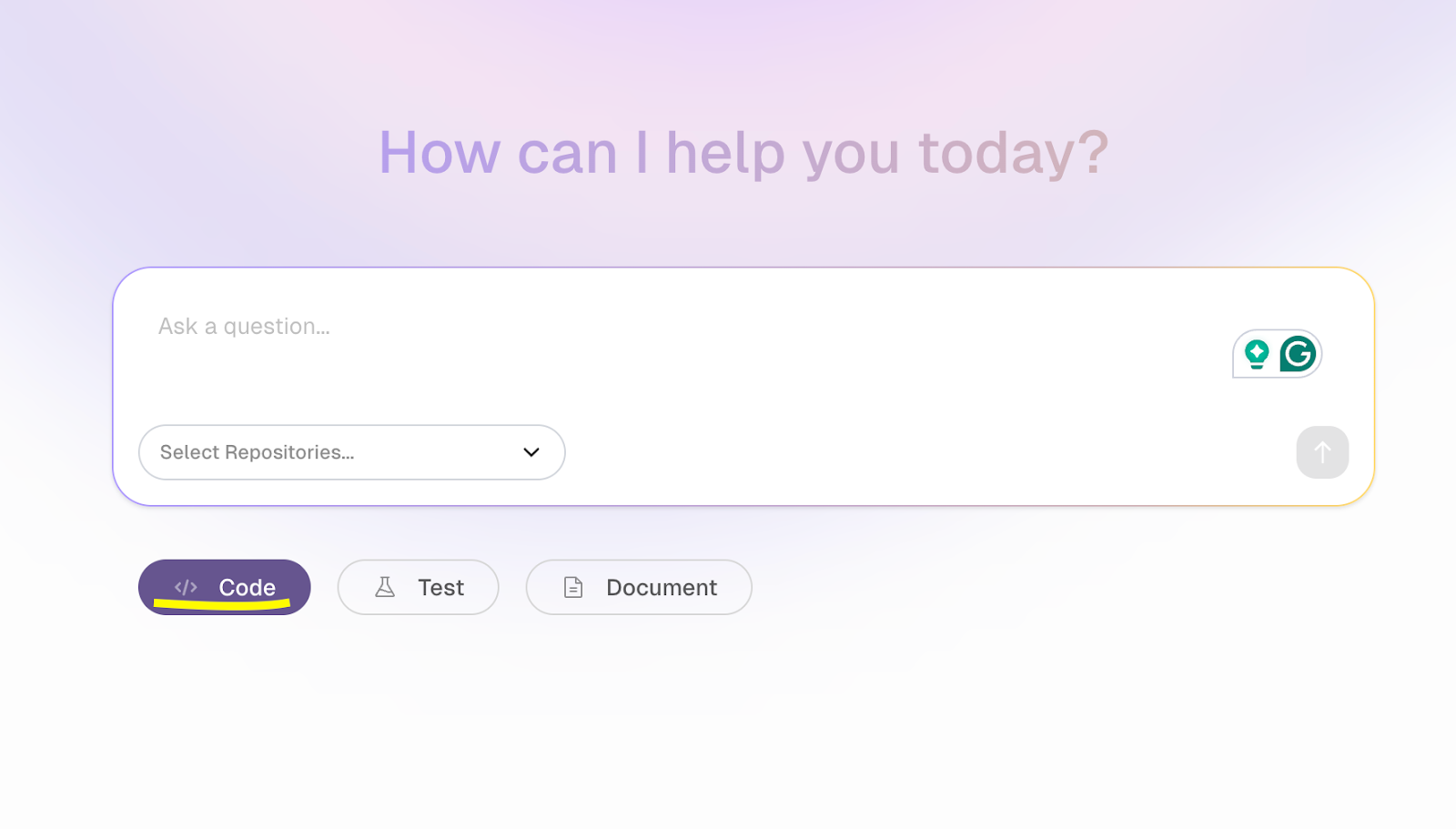
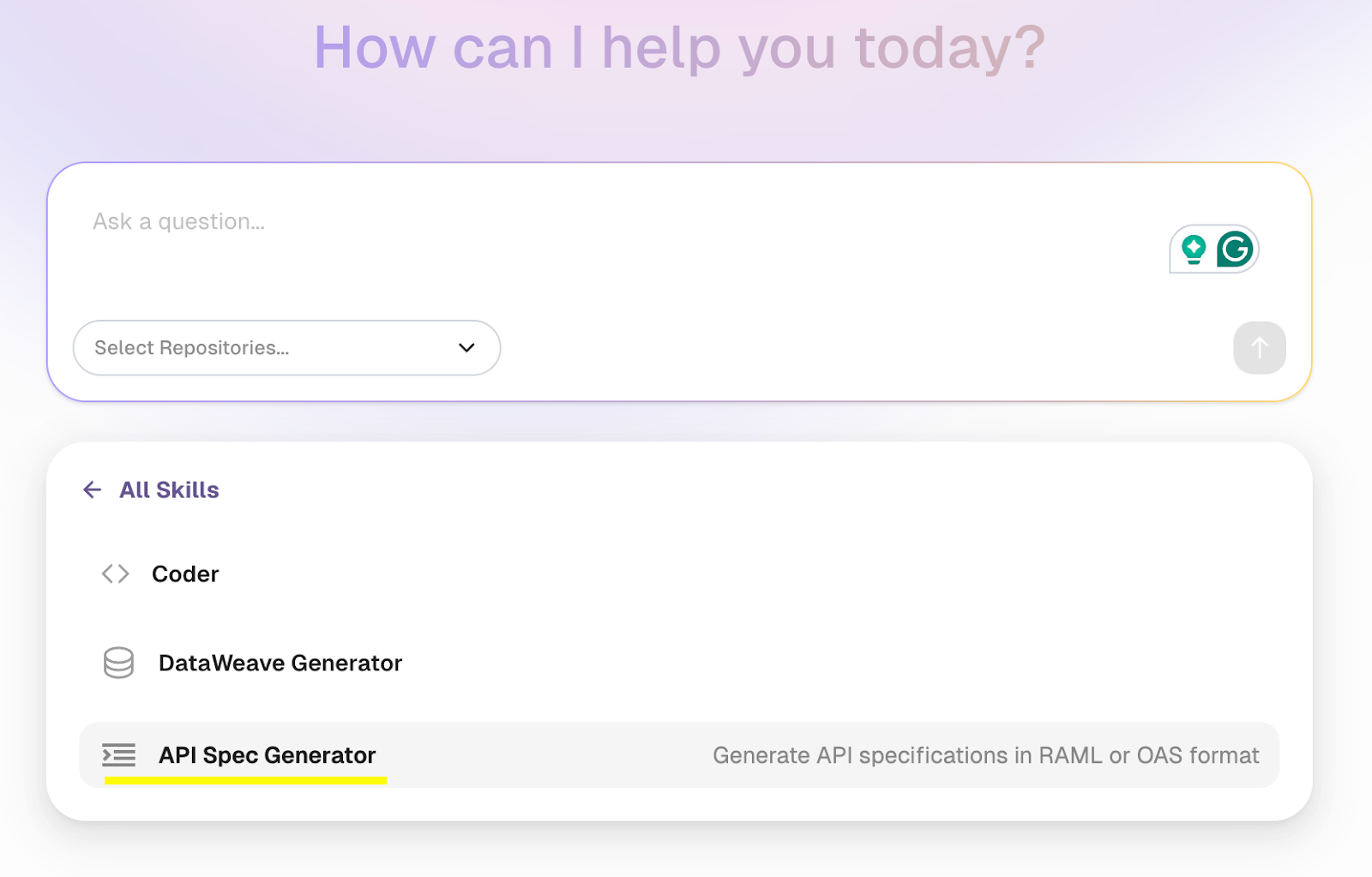
The tool will automatically open the CurieTech AI chat interface, which acts as an agent to help you generate a complete API specification for the Customer Management API based on the specific details you want in the design.
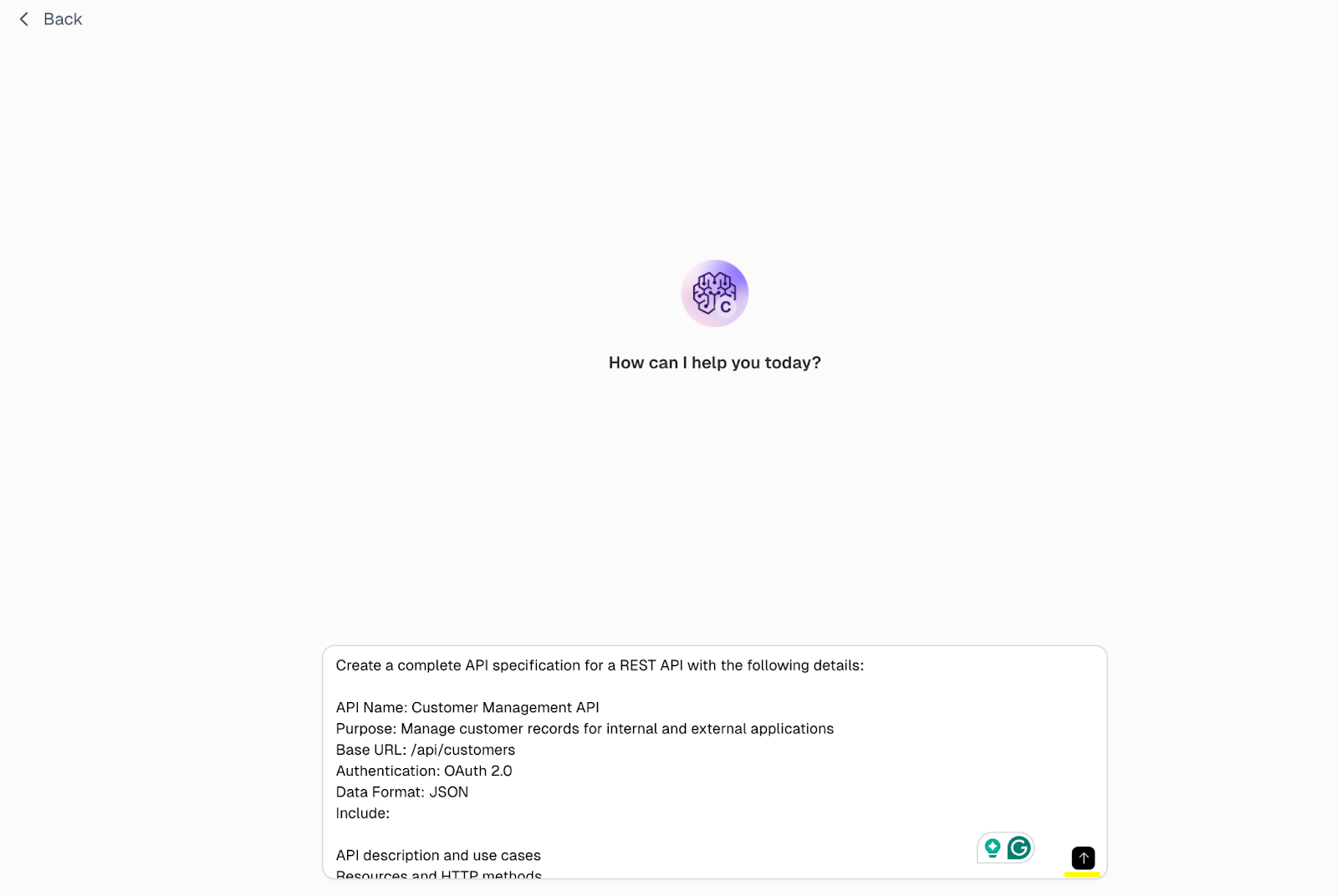
In this case, you will create a comprehensive API specification for the Customer Management API, which manages customer records for both internal and external applications.
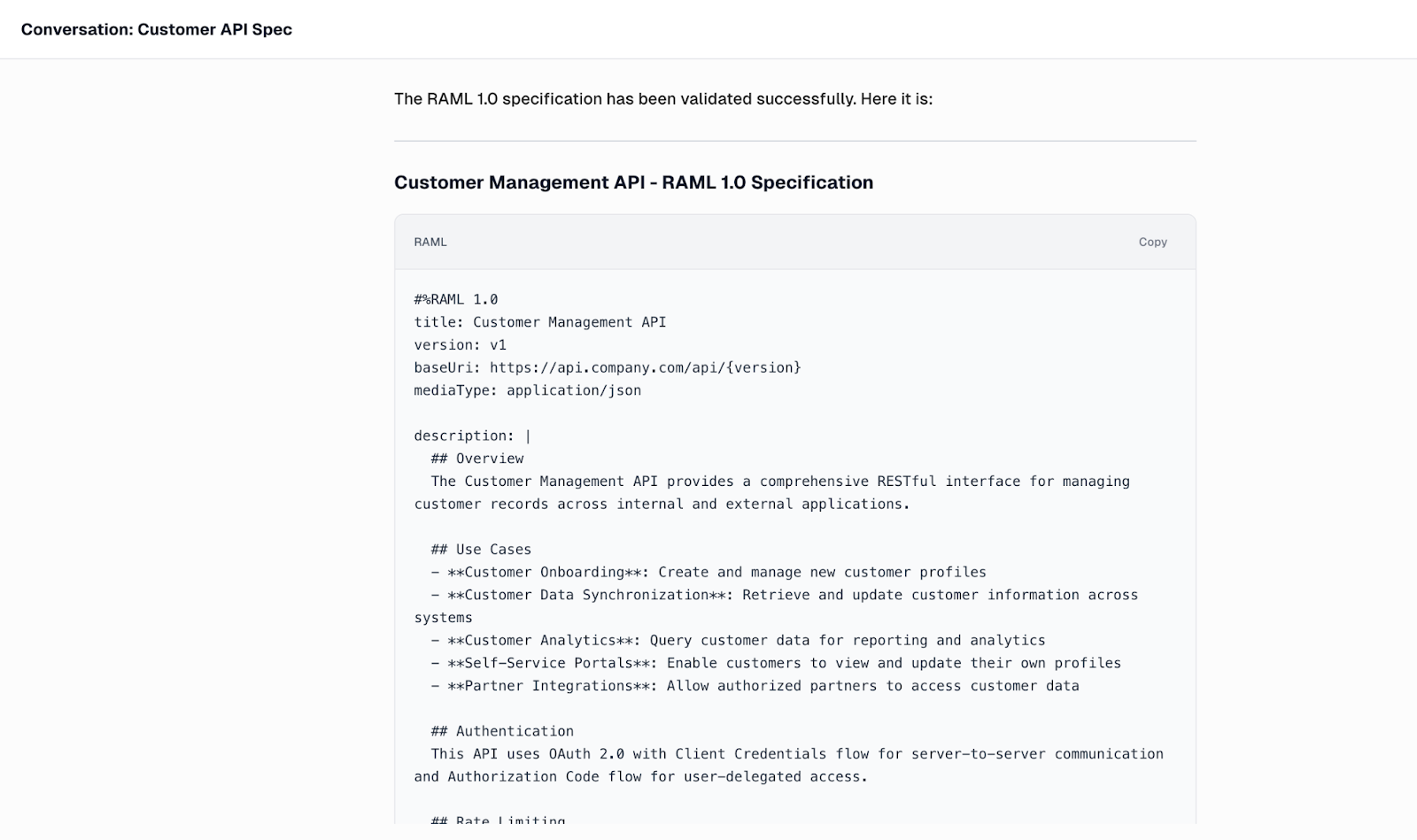
CurieTech AI provides a detailed API specification based on these requirements, which can be used as a starting point for designing the MuleSoft API in Anypoint Design Center.
After generating the Customer Management API specification, the next step is to publish it to Anypoint Exchange so it can be discovered, reviewed, and reused by other teams across the organization.
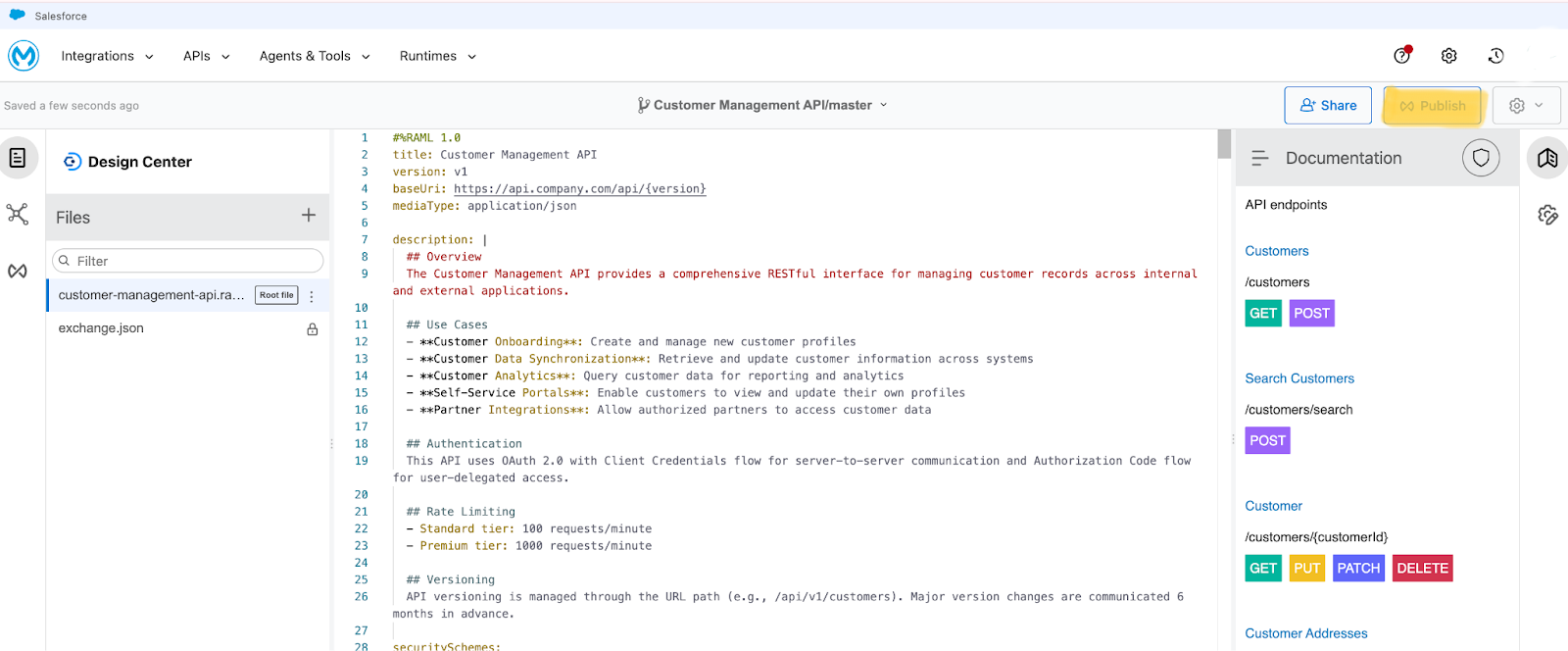
To publish the API specification, click “Publish” and provide the required details, such as the asset name, version, and visibility (private or organization-wide).
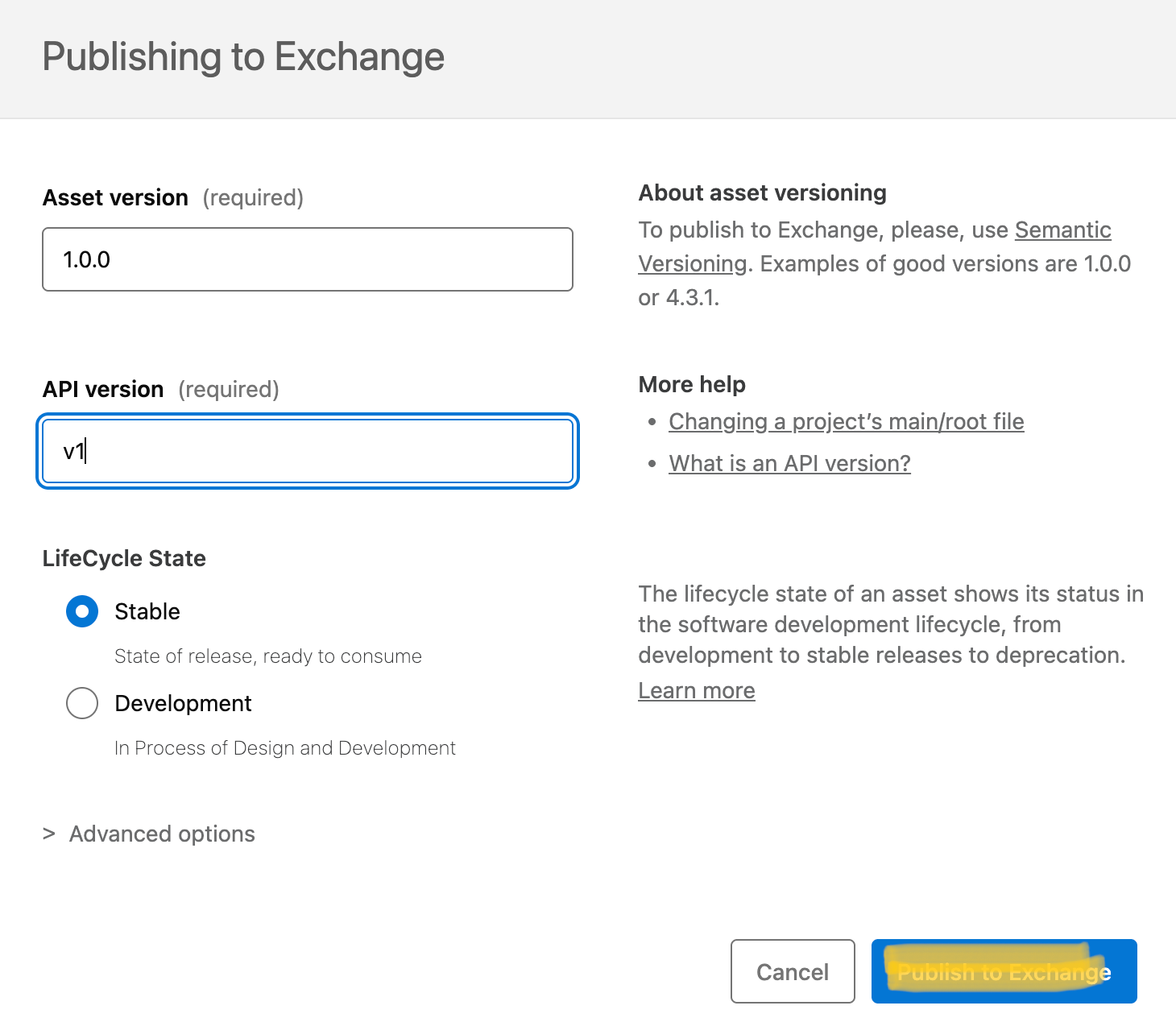
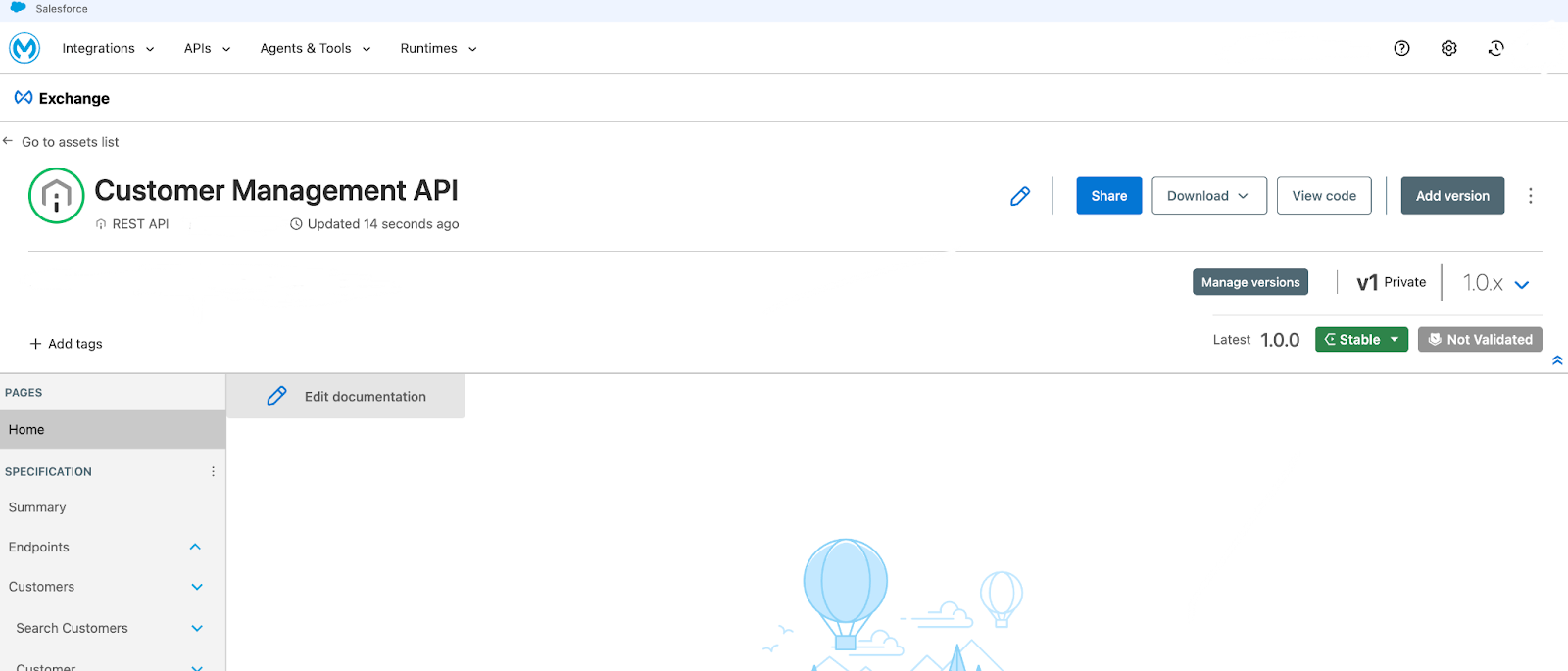
Once all details are complete, click “Publish to Exchange.” This will create an Exchange asset that includes the documentation, endpoints, examples, and security details, all of which are displayed correctly. The published specification then serves as the contract for both API implementation and consumption.
Implementation
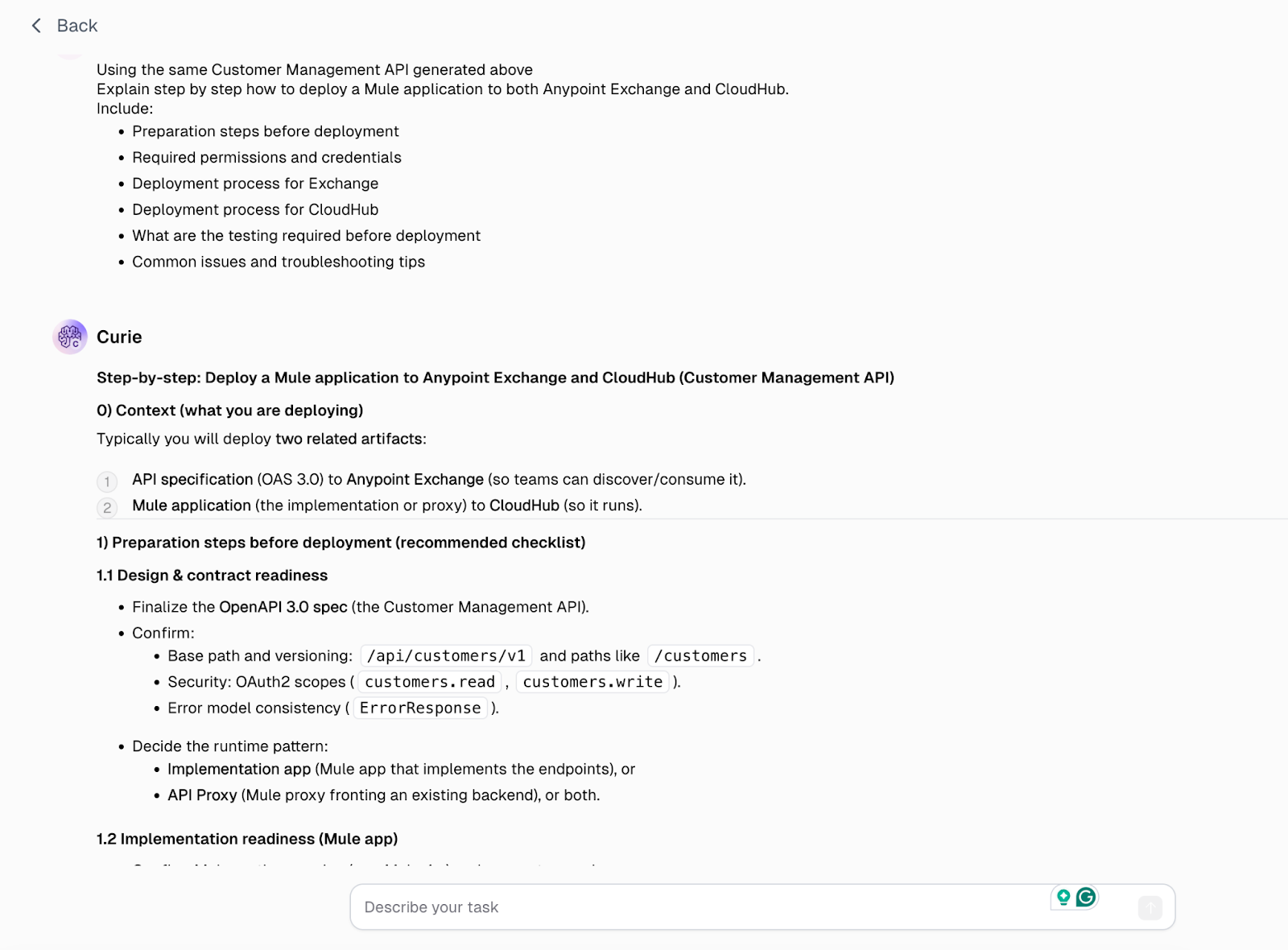
Using the exact API specification you created in the previous section, the CurieTech AI chat interface can also support MuleSoft API implementation. In the screenshot below, you have outlined a step-by-step process for deploying the API to MuleSoft CloudHub or Anypoint Exchange, including preparation steps, required permissions and credentials, the deployment process itself, and necessary testing before deployment.
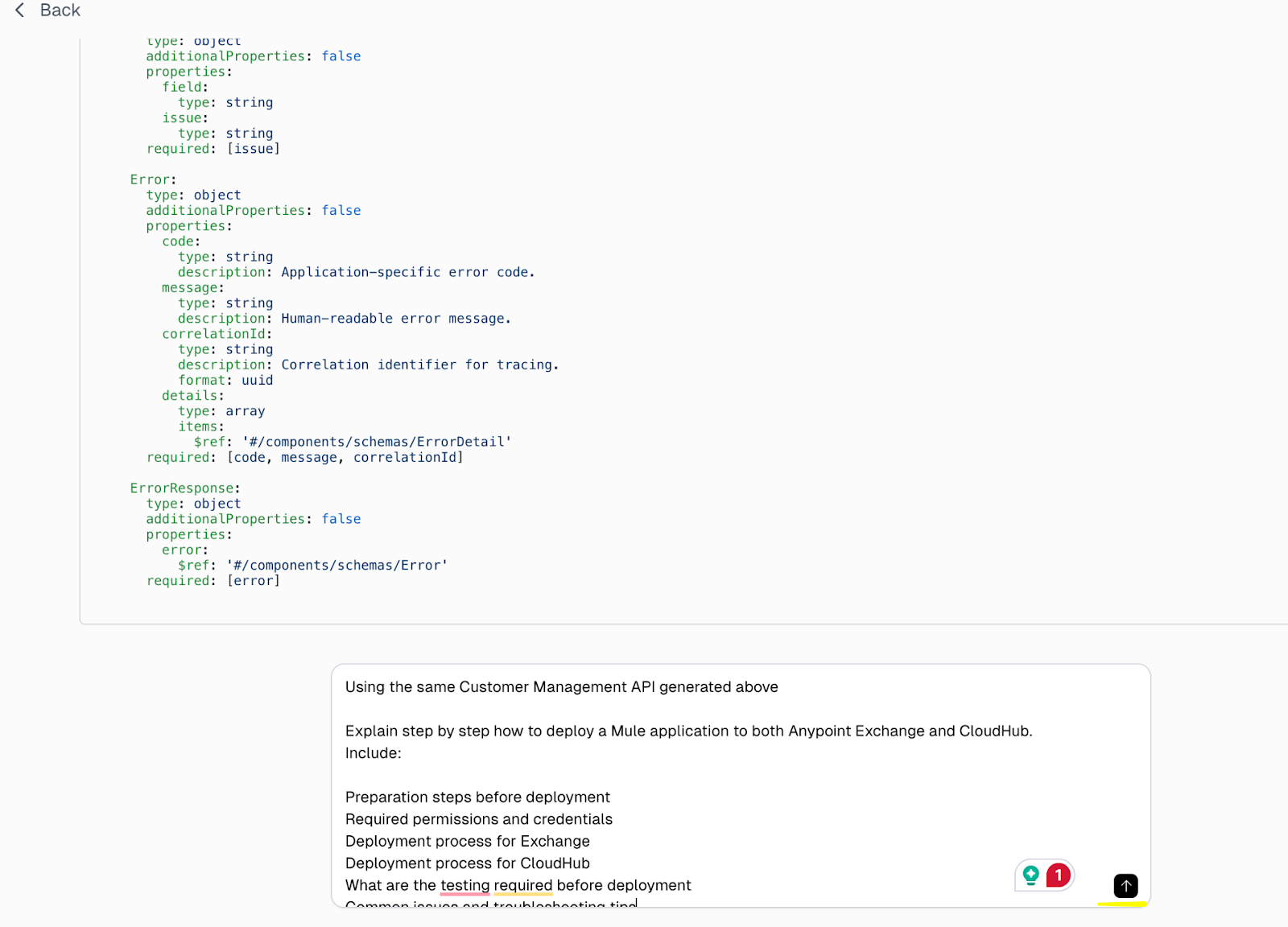
The tool provides a detailed deployment process and identifies any gaps that might have been missed during manual deployment, helping ensure a smoother, more accurate, and more reliable implementation.
Management
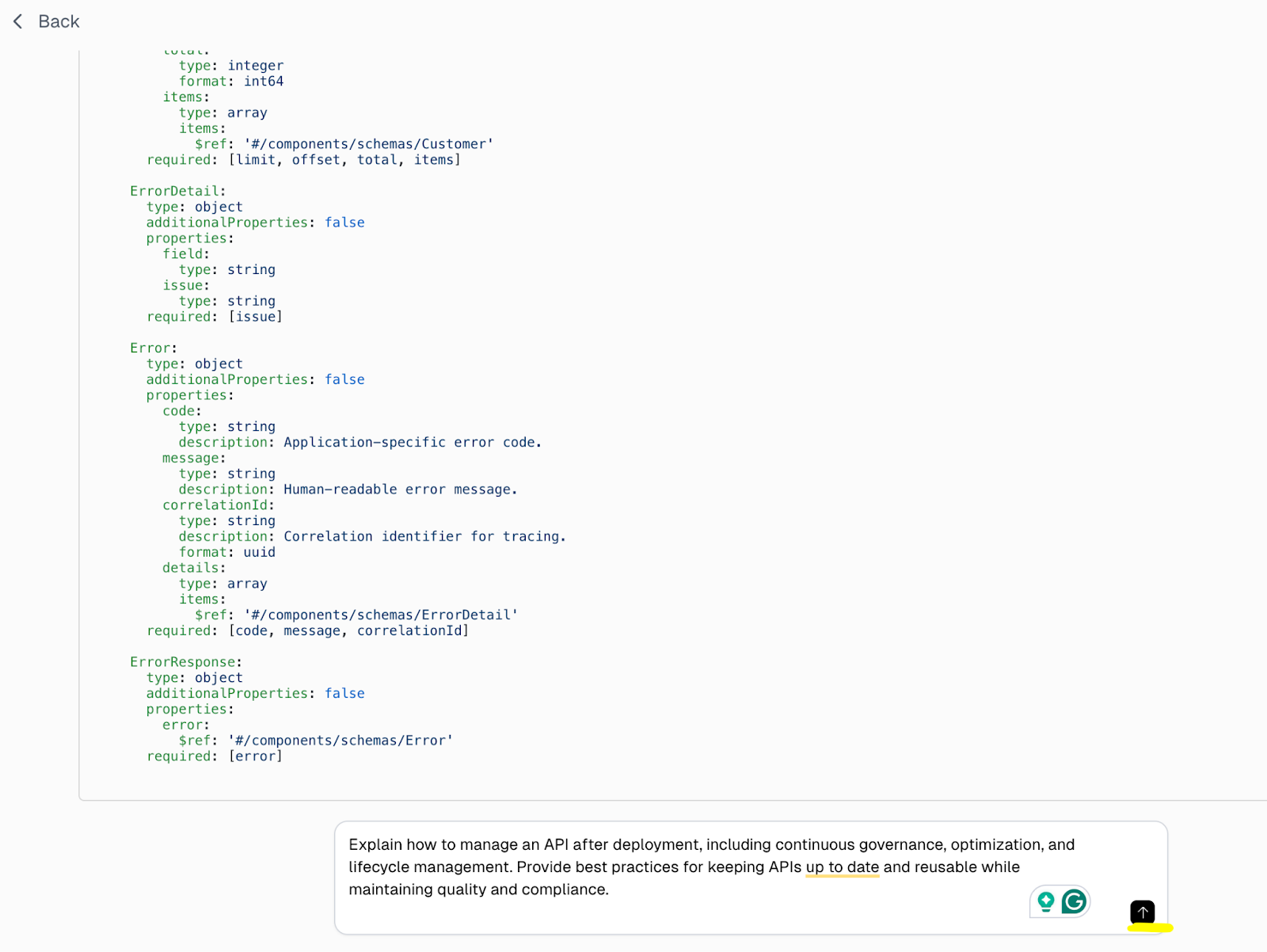
After deployment, the CurieTech AI chat interface can also help you manage the API effectively. In the screenshot below, you use the same chat from the previous section to ask the agent how to manage an API before deployment, including continuous governance, optimization, and lifecycle management, as well as best practices for keeping APIs up to date and reusable while maintaining quality and compliance.
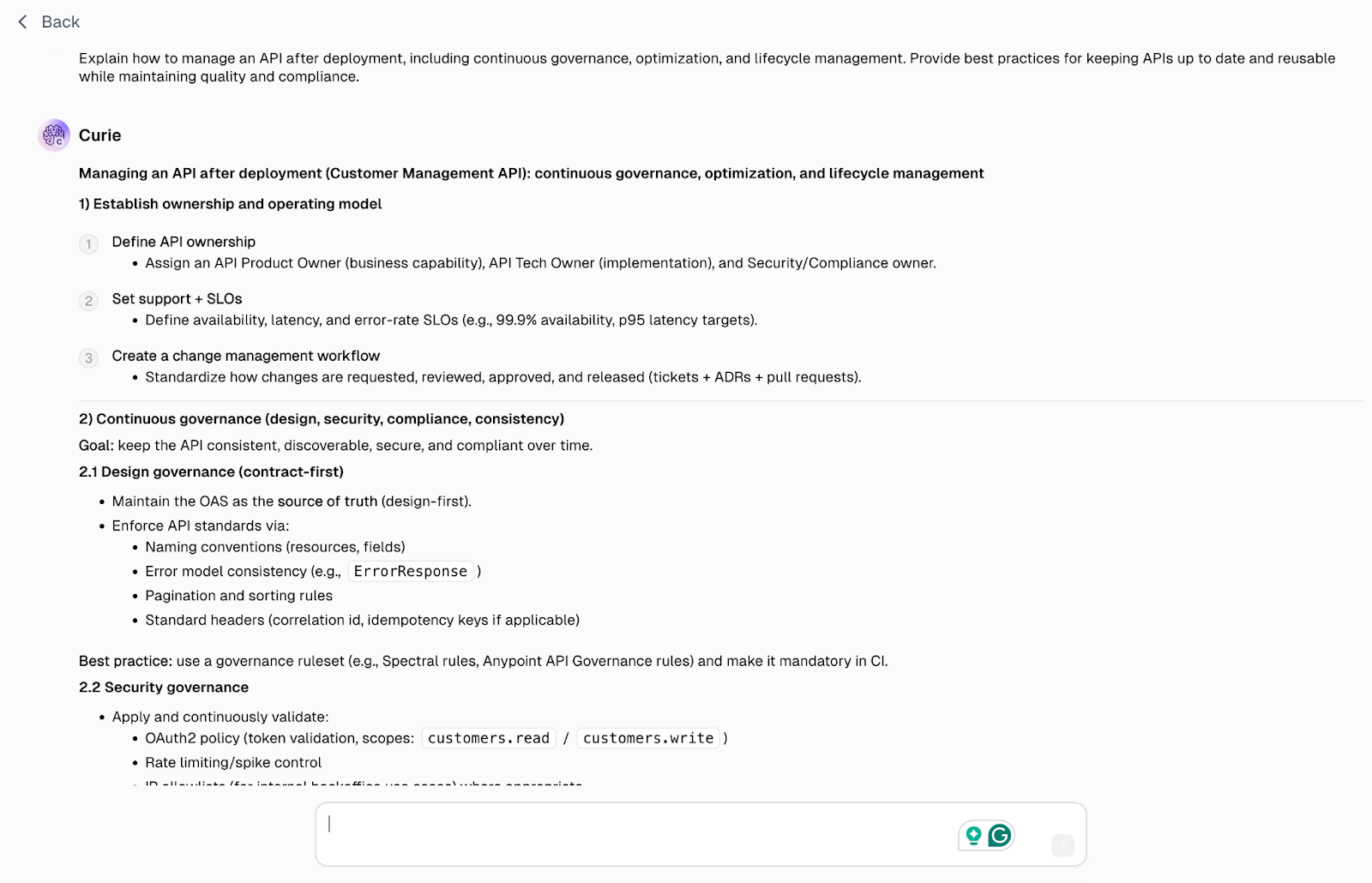
The tool will provide the required details that will help developers streamline API management, enforce best practices, maintain security and compliance, monitor performance, and ensure consistent, reusable, and high-quality API implementations.
Key benefits of MuleSoft API Management
These are some of the key benefits of MuleSoft API Management:
- Manages APIs in one tool: You can manage and monitor APIs with the Anypoint Platform, so you only need one platform to access and manage them, enabling you to track performance and usage while preventing potential issues. Instead of jumping between multiple systems or worrying about scattered tools, teams get a single, unified workspace. This makes daily operations smoother and reduces the time spent troubleshooting across different platforms.
- Enhanced security: MuleSoft API Management enforces standardized security policies across all APIs, safeguarding sensitive data, regulating access, and ensuring compliance.
- Reusable assets: Assets created within Anypoint Platform are reusable, saving the team time through shared connectors, templates, and APIs.
- Performance insights: With built-in analytics, you can easily identify usage trends and performance gaps within our APIs, optimize our integrations, and improve overall efficiency. These insights serve as a health report for your APIs, highlighting what’s working well and where adjustments may be needed.
- Faster development and delivery: MuleSoft’s reusable assets, templates, and connectors help teams deliver integrations more quickly by eliminating repetitive work. Instead of spending days building standard functions, developers can drag and drop existing components and configure them, freeing them to focus on higher-value tasks.
- Enhanced developer experience: With tools such as Design Center, Exchange, and Studio, developers enjoy a streamlined, intuitive workflow. Clear documentation, prebuilt modules, and visual editors help reduce frustration and speed up onboarding for new team members.
Overall, MuleSoft API Management empowers teams with visibility, security, efficiency, and reusability—all in one integrated platform. It simplifies complex tasks, boosts productivity, and equips organizations with the tools to deliver reliable, scalable APIs that support long-term growth.
MuleSoft API Management limitations
While MuleSoft API Management offers powerful capabilities, there are a few limitations to consider:
- Pricing and licensing challenges: MuleSoft’s enterprise-level pricing can be expensive for smaller organizations. Its licensing model—based on cores, environments, and API usage—can make budgeting complex.
- Learning effort: Despite its intuitive design, the platform requires some technical knowledge. Teams may need training or MuleSoft certifications to maximize efficiency.
- Infrastructure and resource demands: Running MuleSoft, particularly in on-premises or hybrid setups, may require substantial infrastructure and DevOps support.
- Policy customization limitations: MuleSoft’s built-in policies are well-suited for common scenarios but offer limited flexibility for complex or highly customized requirements, often necessitating the development of custom policies.
- Dependency on Mule runtime: MuleSoft’s API management tools are optimized for its own runtime, which can limit flexibility when managing APIs built outside the Mule ecosystem.
- Integration complexity in large enterprises: Migrating legacy systems and multiple integration platforms into MuleSoft’s ecosystem requires careful planning and implementation effort.
Despite these challenges, MuleSoft remains one of the most trusted platforms for large-scale API management. With proper planning, budgeting, and training, businesses can minimize these limitations.
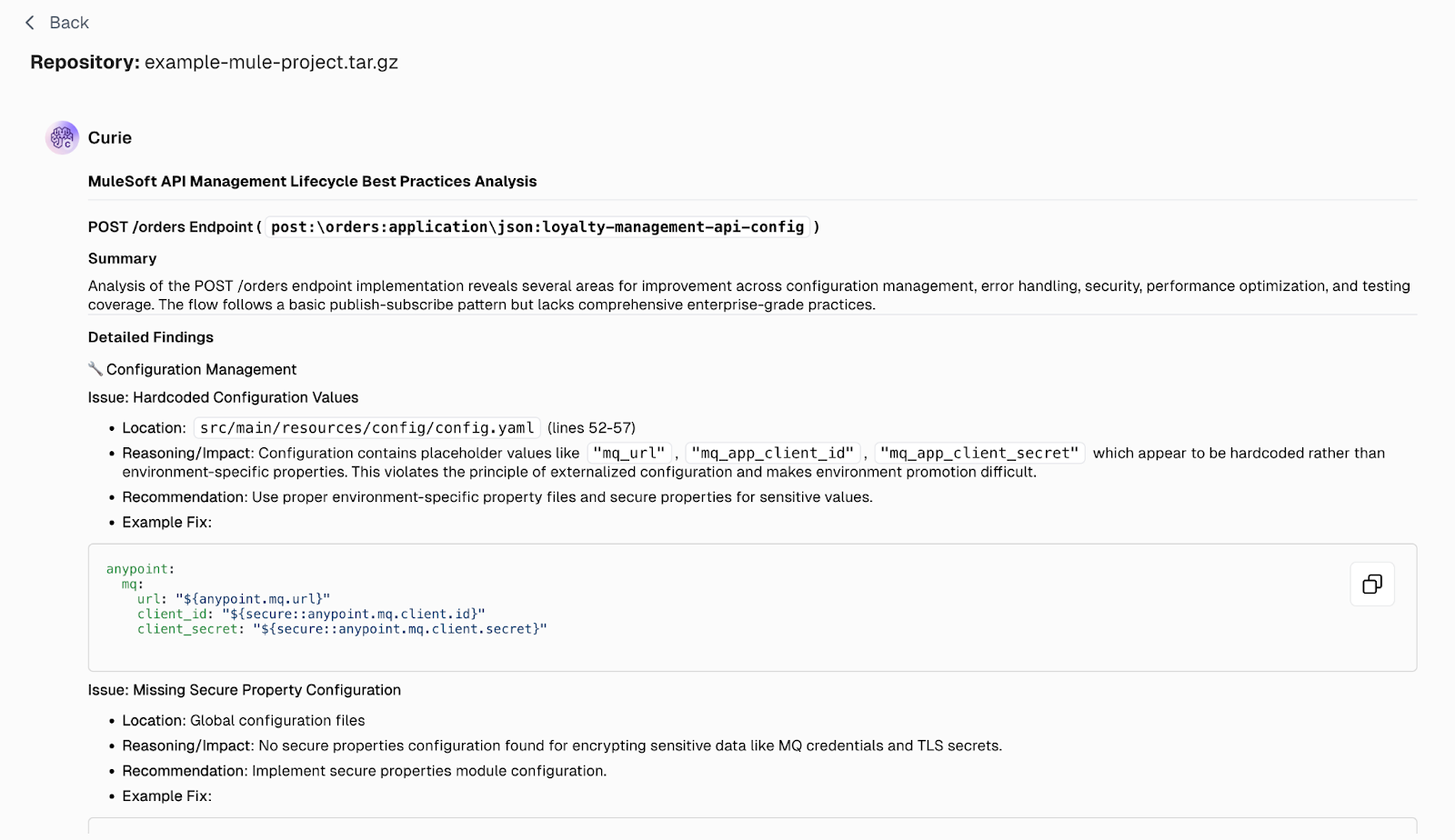
With the help of CurieTech AI, you can review the best MuleSoft API Management lifecycle approaches within your codebase. Through the CurieTech AI chat interface, you can identify potential risks in your APIs and determine the most effective approaches to address them, thereby saving time and resources.
In the screenshot below, we prompt the interface to ask: “What's the best MuleSoft API Lifecycle Process I can follow in an API?”
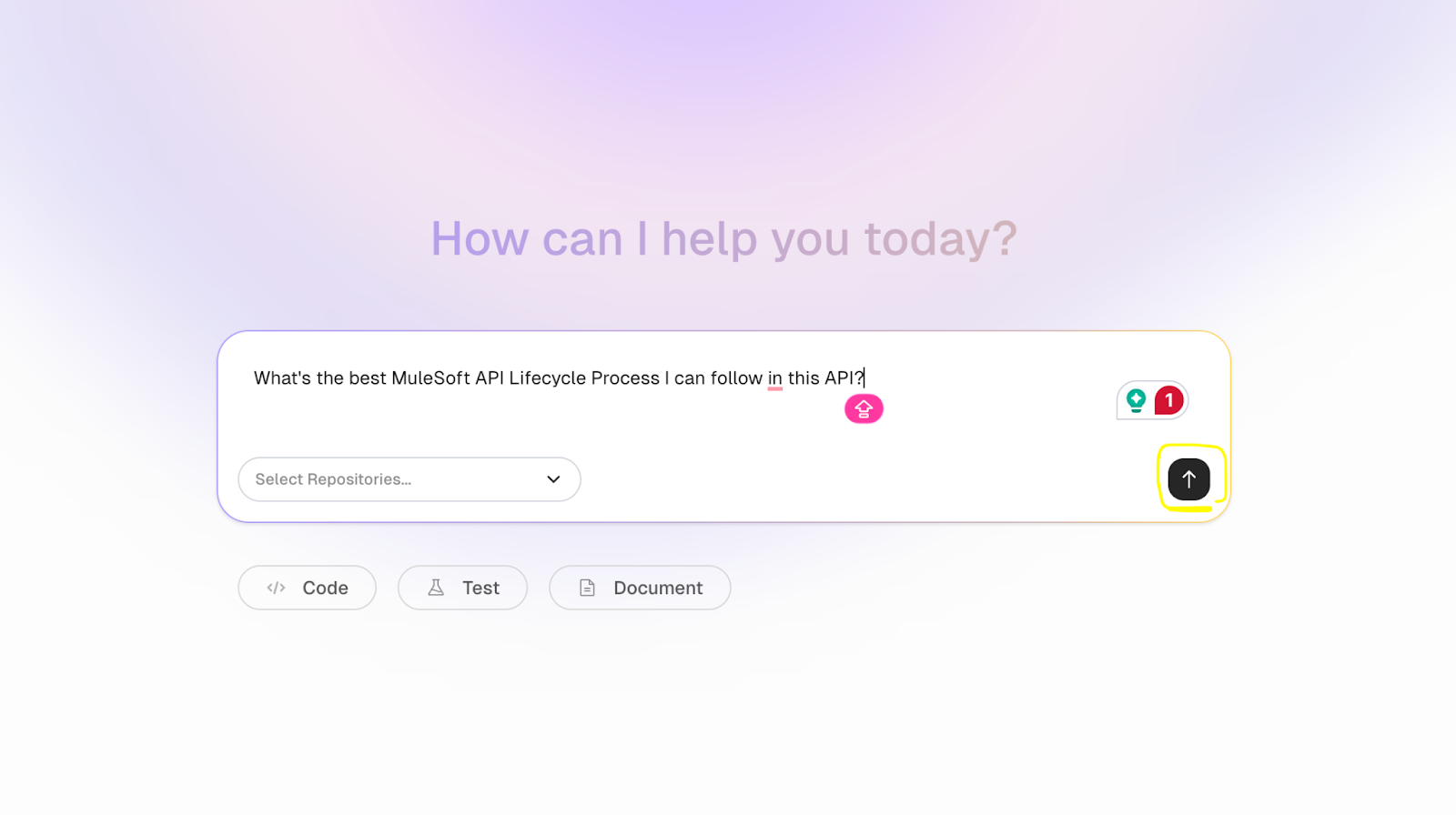
The tool will review each flow, API, and configuration to analyze and identify areas for improvement across design, code quality, security, and performance optimization within our API.
MuleSoft API Management best practices
To maximize the value of MuleSoft API Management, organizations should follow these proven best practices:
- Prioritize reusable API design: Build APIs that can be reused across multiple projects to reduce development time and promote consistency throughout the organization.
- Implement consistent security policies: Apply standardized authentication and authorization methods, such as OAuth 2.0, to ensure that all APIs meet enterprise-grade security standards.
- Monitor and analyze regularly: Use Anypoint Monitoring and Analytics to track performance, detect issues early, and identify optimization opportunities.
- Govern through clear versioning: Maintain API versions to prevent breaking changes and provide a seamless experience for consumers.
- Document and share knowledge: Keep detailed API documentation and encourage internal teams to collaborate through shared repositories.
- Use automated CI/CD: Leverage CI/CD pipelines to streamline deployment and reduce manual intervention during updates.
{{banner-large-table="/banners"}}
Conclusion
As organizations embrace digital transformation, the number of APIs continues to grow rapidly. Without effective management, this growth can lead to fragmentation, inefficiency, and security risks. MuleSoft API Management provides the structure, governance, and visibility needed to keep APIs secure, scalable, and aligned with business goals.
Whether you are automating workflows, modernizing legacy systems, or enabling partner integrations, MuleSoft empowers teams to manage APIs with confidence. Combined with today’s AI tools, it offers even greater opportunities for optimization, helping organizations innovate faster and deliver seamless digital experiences at scale.