
The work that never gets done just got a new owner.
The News
Today we are launching Autonomous Mode in CurieTech AI.
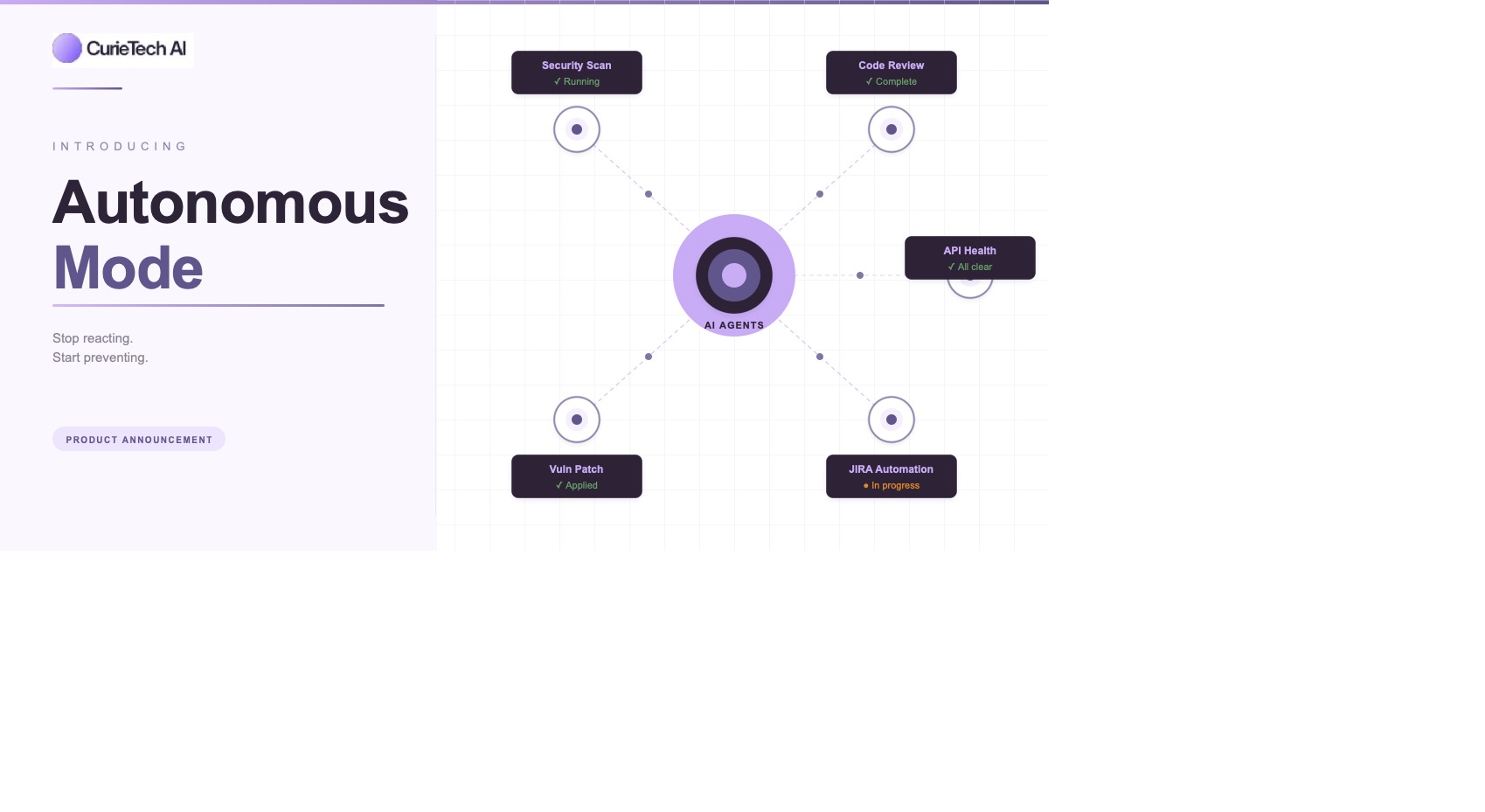
CurieTech AI agents can now run complete integration tasks autonomously on a defined schedule - with no prompt, no ticket, and no developer pulling it into motion. The agents run in the background, do the work, and surface the results.
This is not a new type of reminder or a smarter notification. It is autonomous execution - the kind of work that integration teams have always meant to do but never had time for.
Here is what that looks like in practice:
Security: Repositories are scanned for vulnerabilities on a defined schedule and patched automatically - before anyone raises a ticket.
Code quality: Codebases are reviewed against best practice standards and violations are resolved before they accumulate into technical debt.
API health: Integration tests run on schedule and generate reports before anyone has to ask whether the APIs are healthy.
JIRA Automation: CurieTech AI checks Jira for tickets, picks up assigned tasks, and starts working on them - before the developer has opened their laptop.
Integration teams have always had two categories of work: the work they do, and the work that never gets done. Autonomous Mode closes that gap.
Why we Built Autonomous Mode
Most integration failures aren’t caused by bad code. They’re caused by drift - specs that fall out of sync with what’s deployed, vulnerabilities that sit unpatched for weeks, test coverage that erodes quietly over sprints, API health that nobody checks until a consumer reports something broke.
These aren’t hard problems. They’re neglected ones. And they’re neglected for a simple reason: every sprint, reactive work wins. The production incident is louder than the spec that drifted. The priority ticket gets the developer. The routine scan does not.
Consider a scenario every integration developer has faced. The Jira ticket reads:
“Payroll sync is failing intermittently. Some employee records are not making it to the downstream system. Priority: High.”
No stack trace. No reproduction steps. No indication of when it started. The developer spends three hours hunting logs, tracing a field format mismatch, writing a two-line fix, updating the spec, writing tests, getting a review, and deploying.
That incident would never have happened if automated tests had been running on a schedule. They would have caught the field format change the week it happened - a quiet fix, not a production crisis. That is exactly what Autonomous Mode is built to prevent.

What General-Purpose Coding Agents Are Missing for Integration Work
Autonomous Mode sets a high bar for what an AI agent needs to be able to do: identify the right work, retrieve the right context, execute correctly, and validate the result - all without a human directing it. General-purpose coding agents cannot clear that bar, and the reasons are structural.
They lack domain-specific knowledge and context layers. General-purpose coding agents have no grounding in integration-specific patterns - no understanding of how transformation logic should behave, what connector configurations are valid, or what a correctly structured API contract looks like. Without that knowledge layer, the agent cannot determine what needs to be done in the first place, let alone whether what it produced is actually correct.
They lack the model routing needed for integration tasks. Integration work spans tasks with very different requirements - deep reasoning for root cause analysis, speed for routine generation, precision for transformation logic. A single general-purpose model is not optimised for any of these specifically. Without intelligent routing across models and ensemble selection for harder problems, the agent will consistently produce outputs that look plausible but fail in practice.
They lack verification loops built on integration-specific connectivity. Knowing whether output is correct requires more than reviewing the code - it requires executing against the real environment. That means connectivity to the observability stack, the test runner, the deployment target, and the runtime. General-purpose coding agents are not connected to these systems and cannot close the verification loop. The result is output that has to be handed back to a developer to check, which defeats the entire premise of autonomous execution.
These are not gaps that can be closed with better prompting or a more capable foundation model. They require an architecture that was built for integration work from the ground up.
The Capabilities That Make Autonomous Mode Possible
CurieTech AI is built specifically for integration work. That means it has the three capabilities that general-purpose tools are missing — and that Autonomous Mode depends on.
Domain-specific knowledge and context layers. CurieTech AI brings together project context, platform documentation, organisational knowledge, and business-process context - assembled specifically for the integration task at hand. When it runs in Autonomous Mode, it already knows what correct looks like, what to prioritise, and what to flag. No developer context required.
Intelligent model routing. CurieTech AI routes each subtask to the right model - deeper reasoning models for complex analysis, faster models for routine generation, fine-tuned models for domain-specific patterns. For harder problems, it uses ensemble selection: solving the same problem across multiple configurations and choosing the strongest output. The measure of success is not token fluency. It is whether the code compiles, deploys, and passes tests.
Verification loops built on integration-specific connectivity. CurieTech AI connects to your existing tools - the observability stack, repository, test runner, and project board. This connectivity is not just about access. It is what makes verification possible without human involvement. CurieTech AI can retrieve the right logs, run tests against the real runtime, and confirm that what it produced actually works - closing the loop that general-purpose agents leave open.
Together, these capabilities make Autonomous Mode trustworthy in a way that general-purpose tools cannot match. The developer is not signing off on output they cannot verify. CurieTech AI is doing work it genuinely understands.
A Different Relationship With the Work
Most integration teams are still using AI the way they used Stack Overflow - one question, one answer, one task at a time. It helps. But it does not change the shape of the work, and it certainly does not touch the work that was never getting done.
Autonomous Mode changes both. It reduces the human involvement in triggered work. And it eliminates the human requirement for an entire category of work that previously depended on someone remembering to start it.
The integration teams that will be most productive are not the ones with generic coding agents. They are the ones whose AI understands integration work deeply enough to be trusted to run it - not just when asked, but on its own.
Autonomous Mode is available today. If you are already on CurieTech AI, you can try Autonomous Mode in the platform now. If you are not, this is a good time to start.

.png)
.png)

