

Picture this. You are an IT leader at a large enterprise, managing a complex integration landscape that has been running in production for over a decade. One morning, the contractors who built and maintained those integrations hand in their notice. They are leaving. What they take with them is not just their time — it is years of accumulated context: why that orchestration flow was built the way it was, what downstream systems depend on it, what business rules are encoded in transformation scripts that nobody else has ever had to read. You have agentic automation projects to build, a modernization roadmap to execute, and a leadership team expecting results. And the integration layer your business runs on has just become a black box.
The first response is usually to bring in new engineers. But inheriting a decade of undocumented integration code is not something that ramps up quickly — new team members spend weeks reading through flows line by line, tracing dependencies manually, and piecing together business logic from artifacts that were never designed to be self-explanatory. What should take hours stretches into days. And when teams do turn to general-purpose AI agents for help, the results are not much better — vague outputs, incomplete answers, and prompt back and forth just to establish context the tool was never built to hold. Because enterprise integrations are not general-purpose code. They are built on platform-specific runtimes, proprietary transformation languages, and middleware conventions that generic coding agents have no real grounding in.
What this problem requires is platform-specific knowledge, the enterprise's integration context graph, and an understanding of your integration landscape that deepens over time. That is exactly what CurieTech AI was built to deliver.
The Integration Intelligence Layer Built to Simplify Complexity
CurieTech AI is an AI agent purpose-built for enterprise integration. Its agents natively understand 13 distinct integration platforms including MuleSoft, SpringBoot, TIBCO 5/6, IBM, Oracle, Boomi, Informatica, Node.js, webMethods, SAP, BizTalk, IBM ACE, and more, not at the surface level, but at the level of platform-specific runtime behavior, transformation semantics, and connector logic that only comes from being built for integration from the ground up.
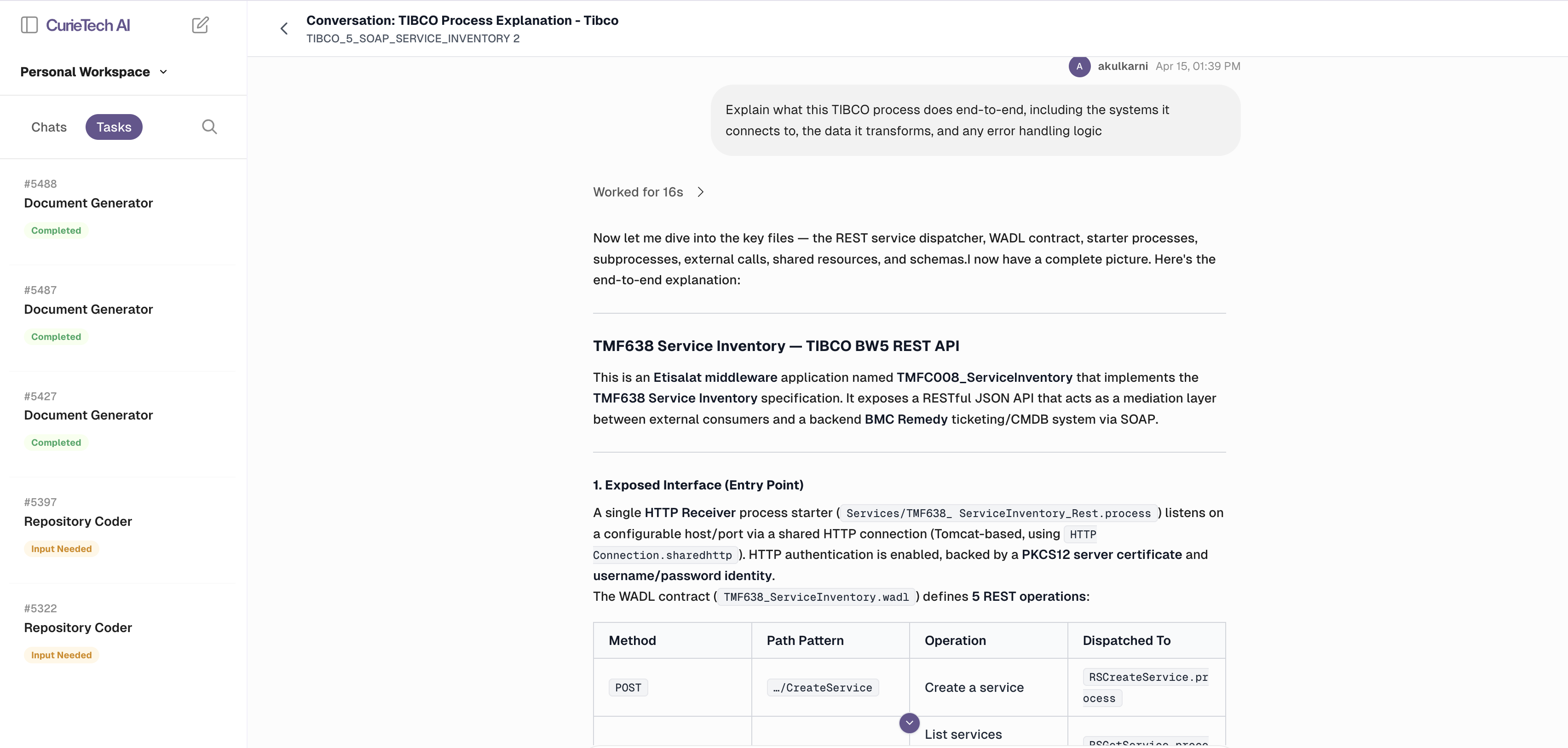
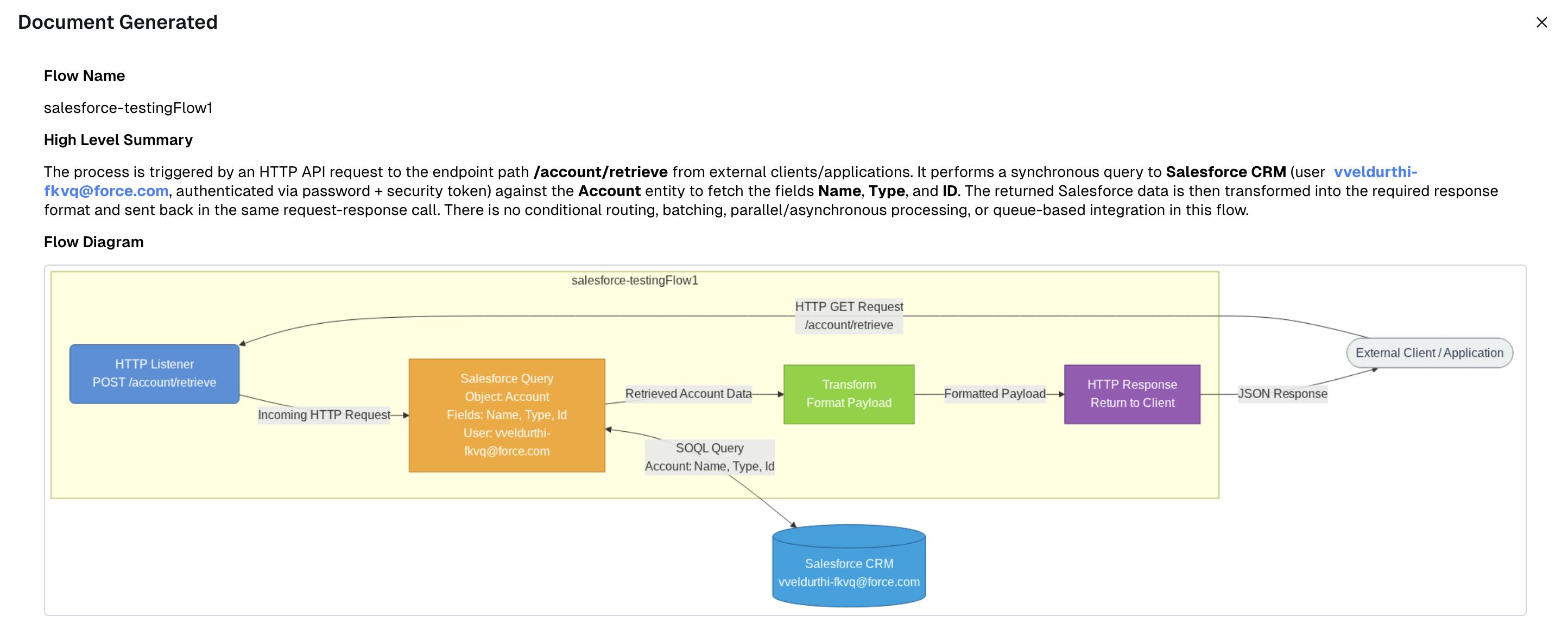
When your team needs to understand what is running in their environment, CurieTech AI builds a ground-truth integration inventory, not what the documentation says exists, but what is live. For each interface, CurieTech AI generates a comprehensive documentation set: a description of what the flow does, flow diagrams and sequence diagrams that make the logic visual, mapping tables that show how fields translate across systems, pseudo code that captures business rules in readable form, and input and output schemas that define exactly what each integration expects and produces.
And because CurieTech AI lets your engineers chat directly with their integration code — asking questions and getting answers grounded in real platform understanding — contractor churn no longer means knowledge loss. Every time a team member moves on, what they understood about the integration landscape stays, documented and available to whoever comes next.
Deep Understanding That Grows With Your Organization
That institutional knowledge CurieTech AI surfaces does not just fill the gaps left behind, it compounds over time. The more CurieTech AI works with your integration landscape, the more it understands your organization's conventions, patterns, and business rules building an intelligence layer that becomes more valuable with every repository analyzed, every question answered, and every interface documented.
That intelligence shows up most clearly when something goes wrong or when something needs to change. Break-fix investigations that once consumed days compress to minutes because the context is already there, no more starting from scratch, no more reading through unfamiliar code line by line. Change requests get evaluated against real data rather than gut instinct. New engineers ramp up on complex integration environments in days rather than quarters.
For many organizations, this is exactly the outcome they are looking for. Not every team needs to migrate to a new platform, many are perfectly well-served by the platform they already run on and simply want to operate it with greater confidence and clarity. CurieTech AI makes that possible, giving teams the visibility and understanding they need to keep building on what they have without the cost, risk, or disruption of moving somewhere new.
Your Integration Landscape Has More to Offer Than Your Team Currently Knows
Every integration landscape has a story, years of decisions, changes, and business logic built up layer by layer by teams who gave it their best. The challenge is not in how the integrations were originally built. It is that over time, the context around that work quietly fades, making it harder for the teams who inherit it to build on it with the same confidence.
CurieTech AI gives your team that visibility back. It brings clarity to integration landscapes that have grown complex over time, surfacing what exists, how it connects, and why it was built the way it was and makes that complexity something your engineers can navigate with confidence rather than work around with caution. Across 13 distinct platforms, without disruption to what is currently running, CurieTech AI gives your team the lens they need to see their integration landscape clearly and the foundation to move forward, whatever that next step looks like.
Curie is purpose-built AI for integration development - APIs, data transformations, and system connectivity. Learn more at curietech.ai.

.png)
.png)

