

Upgrading a Mule application to a new runtime has long been a painful process for integration teams. Between DataWeave changes, connector adjustments, exception handling differences, and regression testing, what looks like a version bump often turns into a multi-week project. CurieTech AI collapses that timeline, what used to take days or weeks now completes in a matter of minutes through a one-click runtime upgrade. And that capability now covers Mule Runtime 4.11.
What CurieTech AI Handles Behind the Scenes
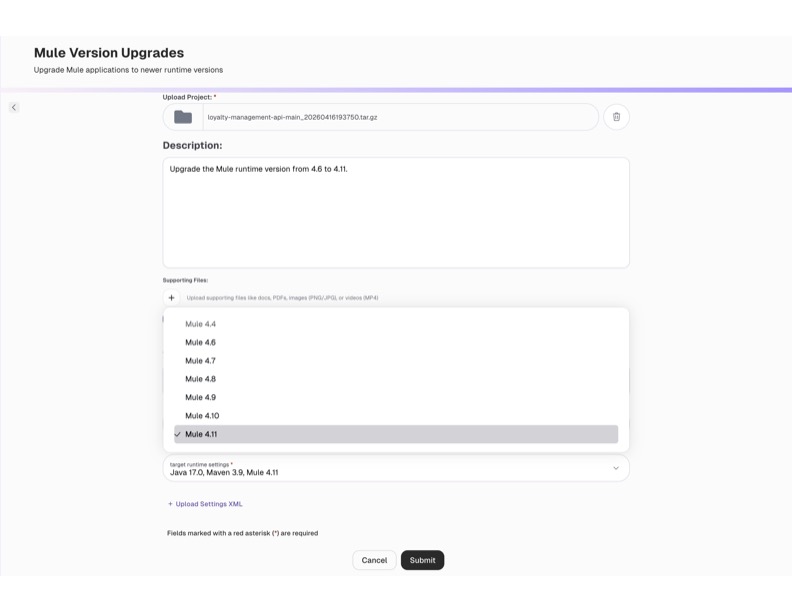
The process is straightforward. Customers provide their Mule application repository, select Mule Runtime 4.11 as the target version, and the agent takes it from there.
What sounds simple on the surface is doing significant work underneath. Most teams underestimate what a runtime upgrade involves updating the pom.xml is the starting line, not the finish line. Mule 4.11 introduces a set of changes that can quietly break an application if not handled correctly:
- Flow refactoring driven by connector upgrades. Several connectors ship with operational changes in 4.11, requiring flows to be adjusted to match the new connector behaviour.
- Advanced batch error handling. Mule 4.11 introduces BatchError objects that enable granular, record-level error reporting — valuable for large-scale data migrations but requiring updates to existing batch error handling logic.
- DataWeave optimizations. Performance improvements in DataWeave change how certain transformations execute, which can surface subtle behaviour differences in existing scripts.
- Improved memory efficiency. Runtime-level memory handling has been tuned in 4.11, affecting how long-running and high-throughput applications allocate and release resources.
- Java 17 as the minimum supported version. Mule 4.11 requires Java 17, meaning applications and dependencies built against older Java versions must be validated and, in some cases, upgraded.
As a coding agent built specifically for enterprise integrations, CurieTech AI understands MuleSoft deeply — not just the structure of Mule applications, but the specific risks that come with moving between runtimes. It already knows where things break. It uses that knowledge to analyse the codebase, classify breaking changes, apply the right fixes, and run validation tests to confirm every flow behaves as expected under Mule 4.11 before anything touches production. Once complete, the upgraded application is ready for review and promotion, with no new tooling, custom migration scripts, or separate workflows required.
The result: up to 80% less manual intervention, fewer production outages, and a significantly shorter upgrade cycle.
Why This Upgrade Matters
Moving to 4.11 is not a cosmetic change. It is how organizations stay within MuleSoft's support lifecycle, close security gaps, and retain access to the newest connector and platform capabilities. The technical reasons to upgrade are clear, CurieTech AI removes the operational friction that usually gets in the way.
Built to Keep Up
Mule 4.11 is the latest runtime CurieTech AI supports, but it will not be the last. The one-click upgrade capability is designed to extend to every future runtime MuleSoft releases, so customers are never caught in a version gap and never facing an upgrade alone.
Whether an application is running on Mule 3.9 or on a more recent 4.x release like 4.6, CurieTech AI can take it all the way to 4.11 in the same one-click experience. No matter where the starting point is, the path to the latest runtime runs through CurieTech AI.

.png)
.png)

