
Why Modernizing Integration Platforms Never Gets Done
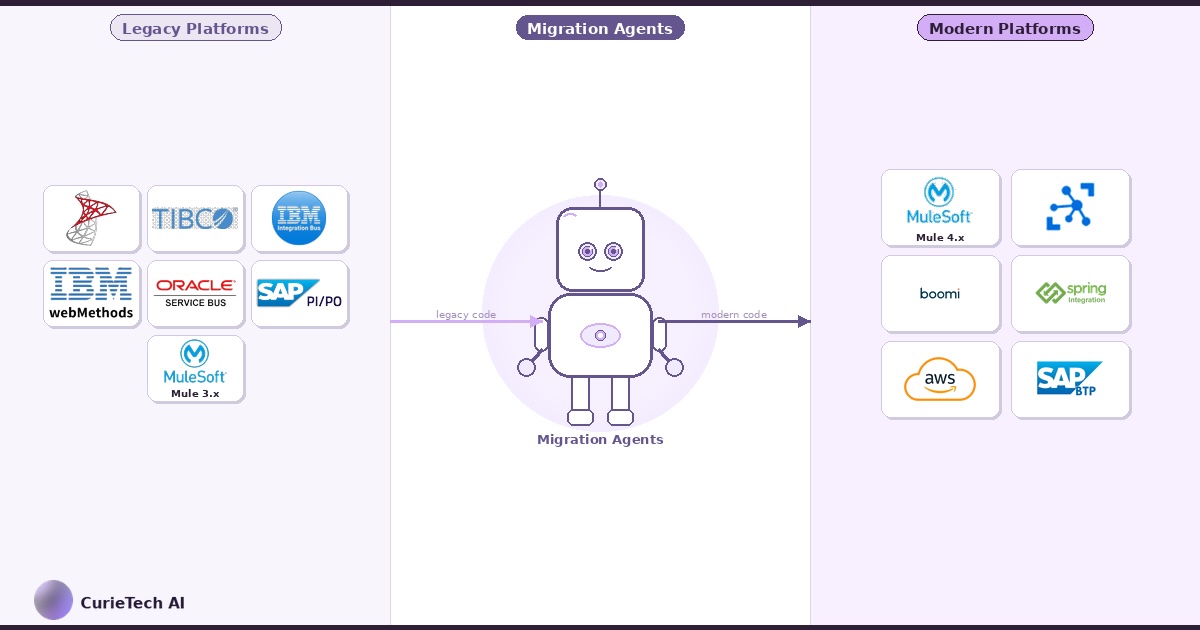
Migrating integration platforms is one of the most consistently painful programs in enterprise IT. Organizations running on legacy platforms - BizTalk, TIBCO, IBM IIB, SAP PI/PO, Mule 3.x - eventually reach a point where migration is unavoidable. A vendor ends support. A compliance requirement can no longer be met. A modernization program demands a clean integration layer. The typical response is to bring in a system integrator. And that is where the real problems begin.
SI-led migrations face three structural problems that no amount of effort fully overcomes:
• Lack of institutional knowledge. The developers who built the legacy system have moved on, taking with them the logic, edge cases, and business rules that were never documented.
• Lack of expertise across two platforms. A successful migration requires deep knowledge of both the legacy source and the modern target - expertise that is rarely found in the same team.
• Variation in the quality of output. Manual migration is only as consistent as the developers doing it, producing a codebase that is uneven in structure and expensive to stabilize before it can go to production.
Introducing CurieTech AI’s Migration Agents
CurieTech AI takes a fundamentally different approach. Rather than augmenting developers with generic AI assistance, CurieTech deploys three purpose-built AI agents - each fine-tuned on integration platform data across 13+ source platforms - that own each phase of the migration end to end.
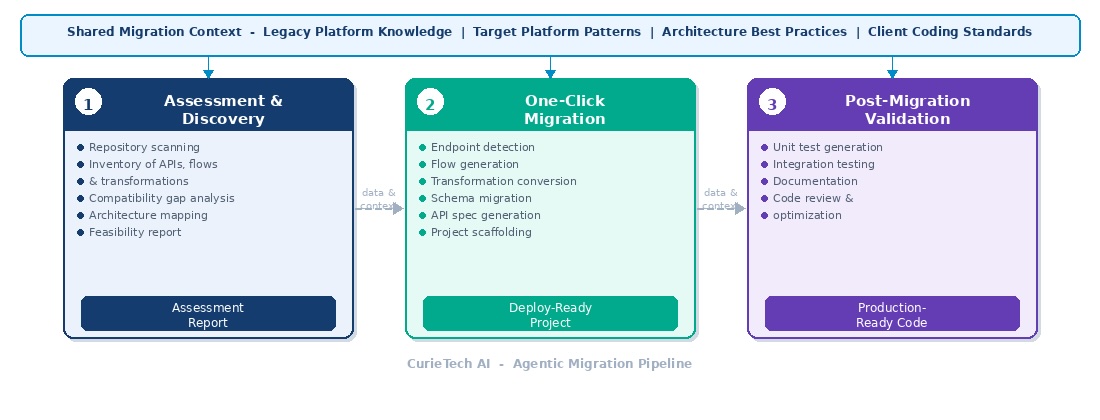
• The Assessment Agent scans and reverse-engineers the legacy environment to produce a complete migration inventory and roadmap before any code is written.
• The Migration Agent converts the legacy codebase into a complete, compiled, deploy-ready project on the target platform of choice.
• The Validation Agent automates testing, documentation, and code review to ensure the migrated project is production-ready before handover.
Together they deliver integration migrations in half the time and at half the cost of any other AI-driven approach - with a fixed price agreed before work begins.
How the Agents Solve Each Pain Point
Each of the three structural problems that make SI-led migrations painful is addressed directly by these agents.
• No institutional knowledge? The assessment agent reconstructs it - reverse-engineering legacy artifacts to build a complete contextual understanding of the environment from what exists, not from what someone remembers.
• No dual-platform expertise? The migration agent is trained on both sides of the migration - understanding the patterns of legacy platforms and knowing how to map them to modern targets including MuleSoft, Azure Logic Apps, Boomi, SpringBoot, and cloud-native architectures.
• Variable quality? Agents produce the same output every time - and the validation agent tests, documents, and reviews every integration before handover, so quality is measured rather than assumed.
How It Works: Three Agents, One Connected Pipeline
The three agents operate as a connected pipeline - not a set of standalone tools. The structured output of each phase feeds directly into the next, carrying shared context and data through the entire migration. This is what makes the efficiency gains compounding rather than additive.
Phase 1 - Assessment Agent
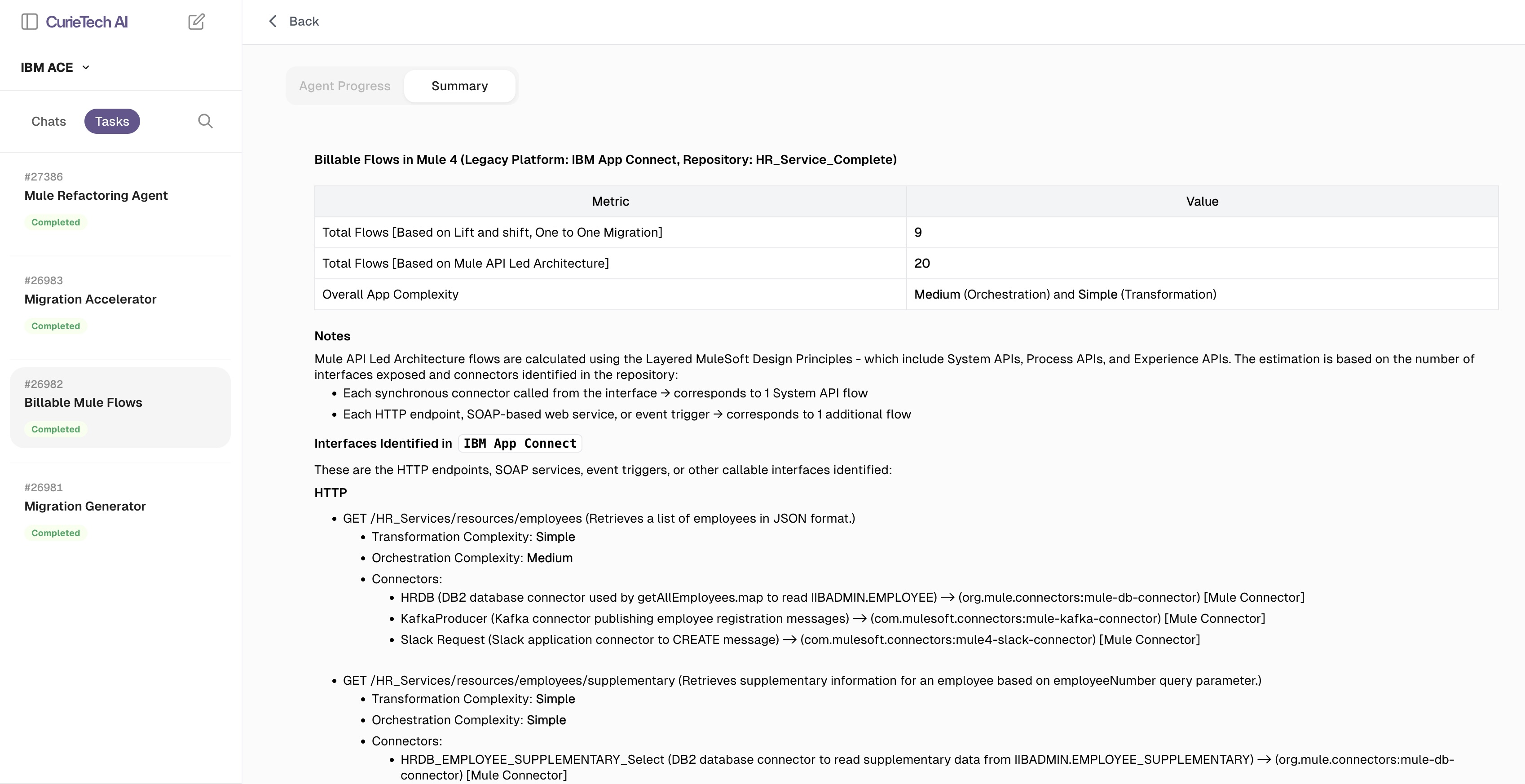
The assessment agent replaces manual discovery with automated intelligence, building the foundation on which the rest of the pipeline runs. Its output underpins a fixed-price quote agreed before any work begins. It has the following capabilities -
• Legacy repository scanning.Makes a complete inventory of APIs, flows, and transformations from the legacy codebase, reverse-engineering all triggers, endpoints, and dependencies.
• Compatibility gap analysis and architecture mapping. Identifies breaking changes between source and target, and maps legacy point-to-point connections into a properly layered architecture driven by the best practices of the target platform.
• Migration risks and feasibility report. Surfaces the migration risks before the migration starts and generates a per-component complexity estimate and migration roadmap - a clear, data-driven basis for scoping and pricing the engagement
Phase 2 - Migration Agent
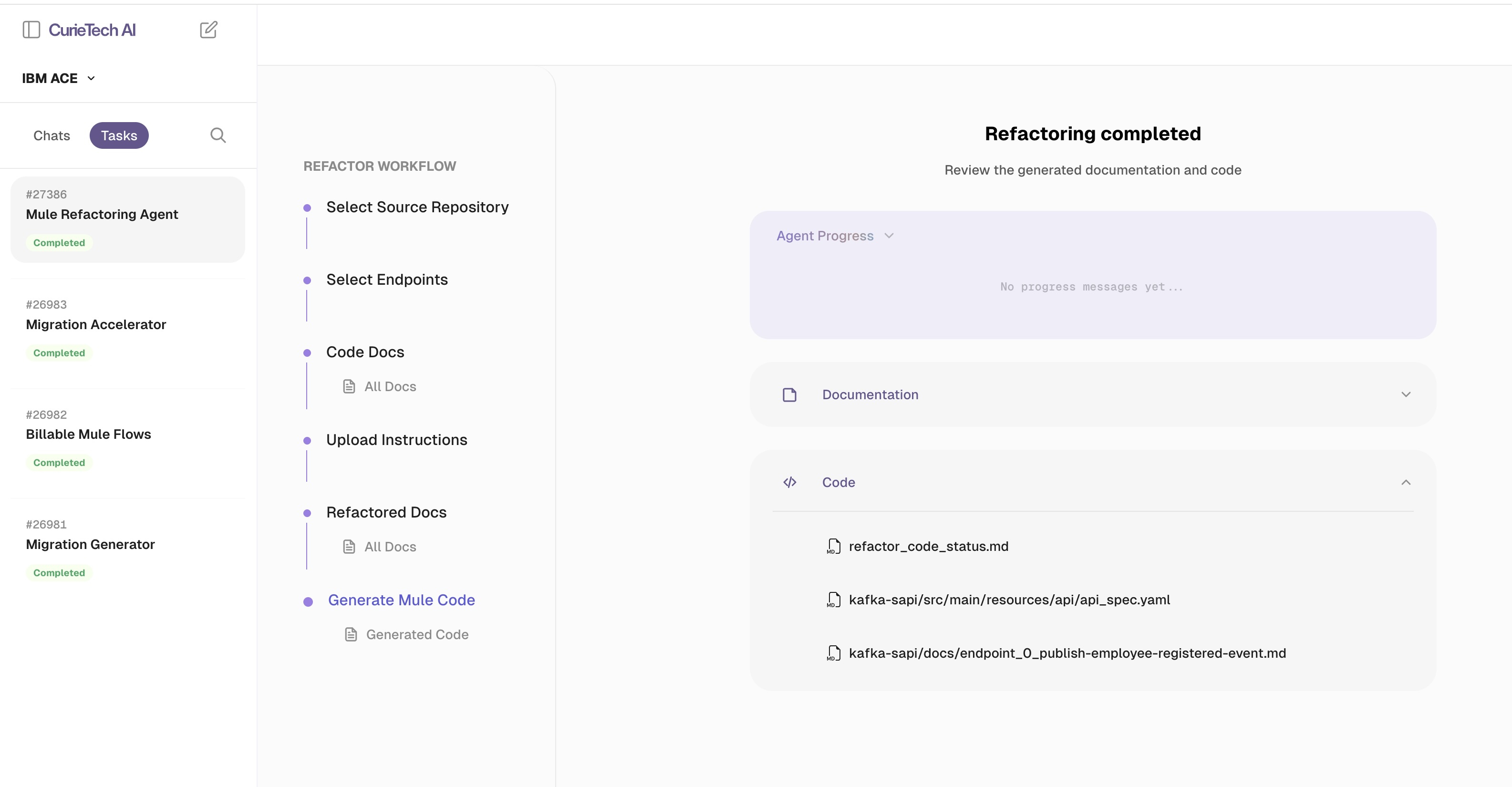
The migration agent automates the full conversion pipeline, producing a complete, deploy-ready project on the target platform. It identifies risks and flags improvements throughout - the output is production-quality code, not a draft that needs cleaning up. It has the following capabilities -
• Flow and transformation generation. Produces complete integration flows structured around layered architectural patterns, and converts legacy transformation maps to the idiomatic language of the target platform.
• Schema migration and API specification generation. Converts XSD, WSDL, and proprietary schemas into target-compatible formats and auto-generates standard API specifications from legacy endpoints.
• Project scaffolding and configuration externalization. Generates a complete target project structure with proper dependency management, with hardcoded values extracted into environment-specific property files.
Phase 3 - Validation Agent
The validation agent automates the full quality loop after migration - the phase where most of the cost and delay in traditional engagements accumulates - ensuring the delivered project meets production standards before it leaves the pipeline. It has the following capabilities -
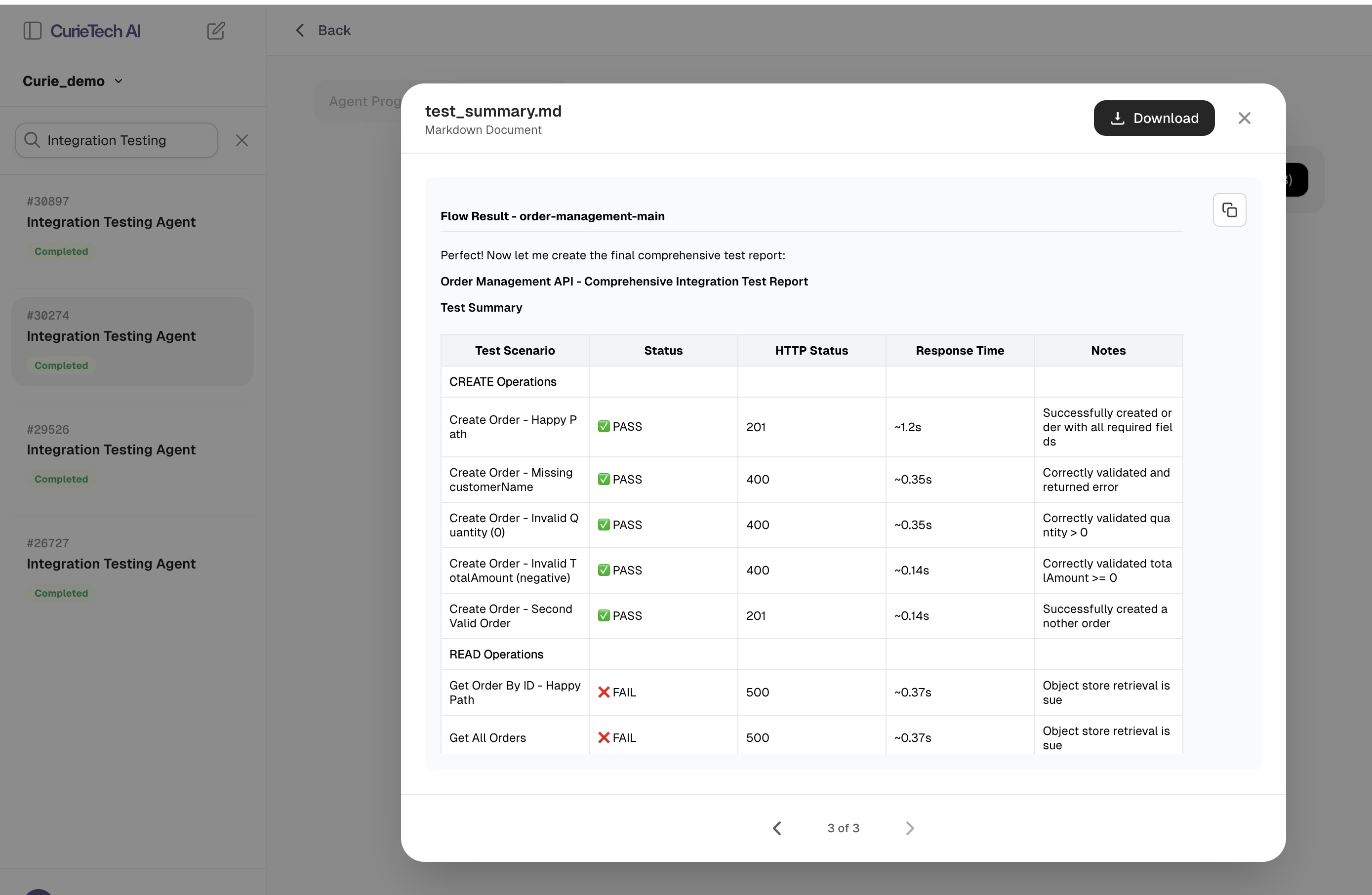
• Unit and integration test generation. Creates unit tests with 95% coverage and end-to-end integration tests that matches inputs and outputs in both the source and destination platforms.
• Documentation generation. Produces migration maps, sequence diagrams, flow diagrams, and mapping tables automatically - complete at the point of handover.
• Code review and optimization. Scans the migrated codebase for security vulnerabilities, performance bottlenecks, and best-practice violations before the project is handed over.
The Difference It Makes
The three agents together change what integration migration costs, how long it takes, and how confidently a team can commit to it. Assessment eliminates discovery risk. Migration eliminates execution variability. Validation eliminates quality uncertainty. Each of the three structural problems that make SI-led migrations painful is resolved - not worked around.
Scope is understood before work begins. Quality is measured before handover. The deliverable is a complete package - code, tests, documentation - not a codebase that needs weeks of stabilization. And cutting delivery time and cost by half compared to any other AI-driven approach is not an incremental gain - it is the difference between a migration program that gets approved and one that gets cut.
Start with an automated assessment - CurieTech AI will inventory your integrations, map your architecture, and produce a fixed-price migration roadmap before any work begins.
Learn more here

.png)
.png)

