

Most integration migrations break in the same place: halfway through execution, when the hardest problems finally surface and the timeline and budget are already gone. The fix is not better project management. It is seeing those problems before execution begins.
CurieTech AI's Assessment Agent is built for exactly this. By deeply analyzing the source integration landscape before any code is migrated, it surfaces the risks that normally derail programs and turns them into known inputs you can plan around. Risk discovery moves from mid-program firefight to a deliberate, upfront step.
Why migrations go wrong: the risks you cannot see are the ones that hurt
Integration code rarely tells the full story of why it was built the way it was. The architectural decisions made at the time made sense given the requirements and system landscape that existed then. But when migration comes, that context is often the first thing missing. The developer who designed the flow may no longer be around. The documentation reflects what the system was meant to do, not how it actually evolved. The institutional knowledge that filled those gaps has quietly walked out the door.
This is where the worst migration risks live: in the gap between what the code appears to do and what the system actually does in production. You cannot plan for risks you have not yet seen, and you cannot see them without deeply analyzing the source. Every migration that unravels mid-program is, at its root, a migration that started before this gap was closed.
The risks CurieTech AI surfaces upfront
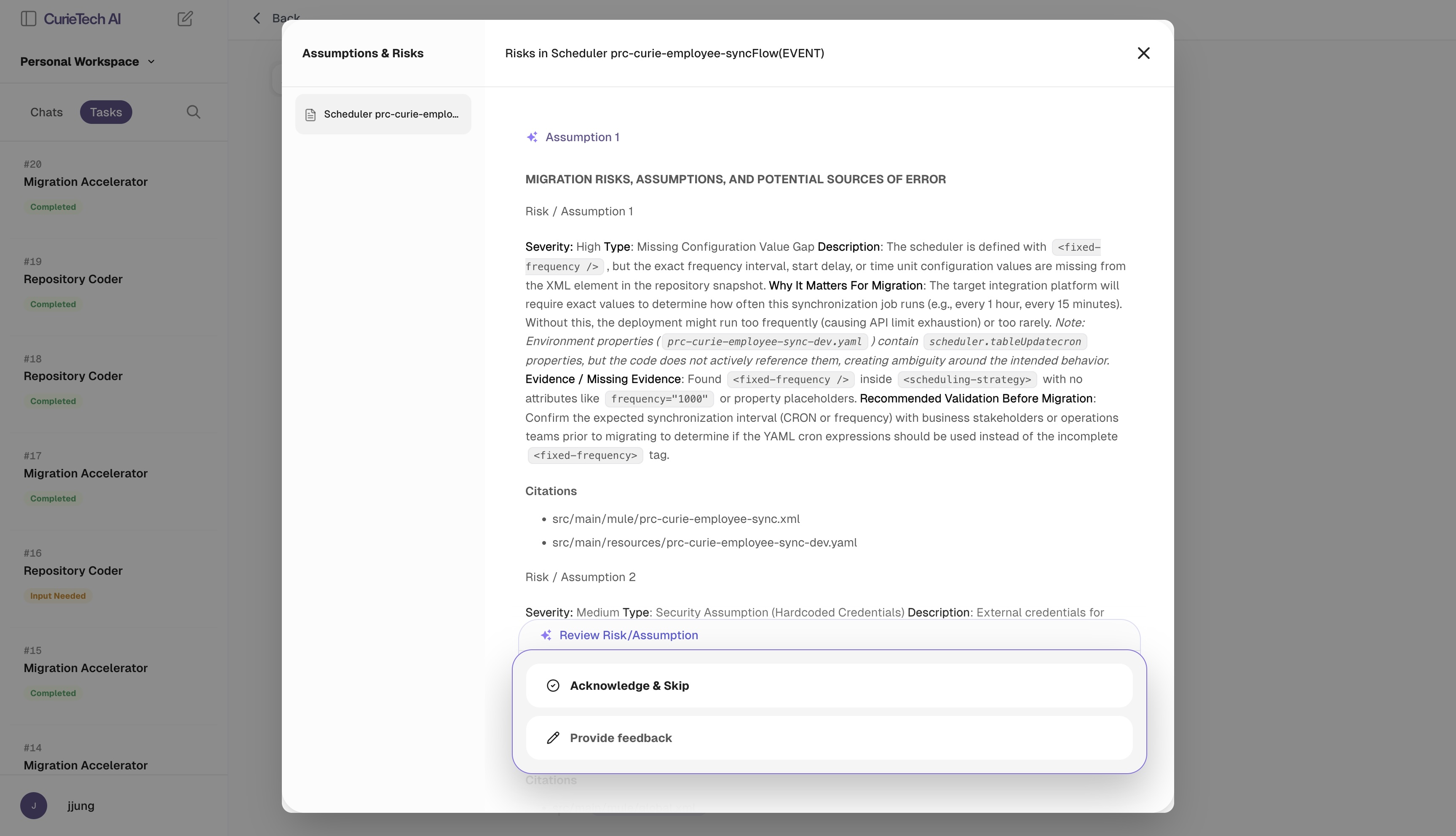
The risks that derail migrations are rarely obvious from the outside. They look like ordinary code until they aren't. Here is what the Assessment Agent typically uncovers before execution begins, and why each one is far cheaper to find now than later:
• Silent data failures from schema and field mismatches. A field maps one way at the source and another at the target. Neither side throws an error during development — the mismatch only surfaces in production, when a downstream application stops receiving the data it expects. Found upfront, it is a mapping decision. Found later, it is an outage.
• Hidden dependencies that live outside the project. A flow references a shared enterprise logging service that sits outside the integration project entirely. The code points to it, but it is not part of what gets migrated. If nobody catches this upfront, telemetry quietly disappears on the target platform with no error to show for it.
• Dynamic behaviour the code alone does not reveal. A pipeline routes inbound requests using a dynamic routing table. In the code, there is one active path. In production, there are several more, injected through configuration files that were never part of the repository. Migrate what is in the code, and you have migrated an incomplete system.
Each of these is a different shape of the same problem: a risk that is invisible during planning and expensive during execution. Identified upfront, they become line items in the plan. Discovered mid-program, they become the reason the program is in trouble.
How CurieTech AI surfaces these risks before execution
Instead of treating discovery as a manual task spread across weeks of interviews and code-reading, the Assessment Agent reverse-engineers the source integration landscape directly from the code itself. It produces a structured view of how each flow actually behaves: business logic in plain language, mapping tables, pseudo code, and sequence diagrams, all grounded in real analysis of the codebase rather than approximation.
From that foundation, it does the work that matters most for risk: it identifies which flows will migrate cleanly, which connectors have no equivalent on the target platform, which transformations need to be rearchitected, and which dependencies reach outside the project boundary. The output is not a generic assessment report. It is a specific, evidenced map of where the migration will be easy, where it will be hard, and where the unknown unknowns are hiding.
All of this happens before a single line of target code is written.
What changes when risk discovery comes first
When migration risks are visible before execution begins, the dynamics of the entire program shift. Scope is defined against real data, not assumptions about what the source system probably does. Timelines reflect reality, because the hard problems are identified and estimated upfront instead of discovered mid-flight. Architectural decisions get made deliberately, by the right people, with the right context — not improvised under deadline pressure when something unexpected appears in week ten.
Most importantly, the team moves into execution knowing exactly what they are dealing with. The surprises that normally define migration programs are gone, because they were never surprises in the first place — they were discovered, named, and planned for before the work began.
That is the shift CurieTech AI is built to deliver. You see your migration risks before you write a line of code, and you plan against reality instead of assumption. The hard problems become visible on day one, not day ninety.

.png)
.png)

