
MuleSoft Development Services: AI-powered Acceleration
While many organizations have the technical capabilities to build integration solutions in-house, others choose to engage MuleSoft Development Service Partners for varying reasons. These partners bring deep platform expertise and extensive real-world experience, accelerating digital transformation initiatives in a competitive market.
With the rise of artificial intelligence, enterprises now have a new option. They can use an AI agentic tool to develop, test, document, maintain, or modernize their API-based integrations, delivering them in half the time at half the cost, along with lighter support services.
This article explores when to engage a MuleSoft Development Service Partner and how to select a partner for different integration needs. It also examines an alternative approach using a specialized MuleSoft AI platform to accelerate delivery and reduce cost.
Summary of decisions involved in selecting the right MuleSoft Development Service partner
{{banner-large-4="/banners"}}
Use cases for engaging a MuleSoft Development Service Partner
As organizations add integrations to their MuleSoft (iPaaS) solutions, unmanaged APIs and inconsistent patterns quickly accumulate into technical debt. Without the right architectural foundation, integrations can quickly become tightly coupled, unreliable, and unscaleable. Also, as the number of integrations increases, deployment automation and observability become common problems.
This is where engaging a MuleSoft Development Service Partner can help build a strong foundation for your MuleSoft implementation. MuleSoft Development Service Partners bring knowledge about proven delivery frameworks and reusable accelerators to help organizations tackle the issues quickly. They can ensure integrations are architected correctly in line with requirements, establish security and governance standards, and enable teams to scale MuleSoft adoption sustainably.
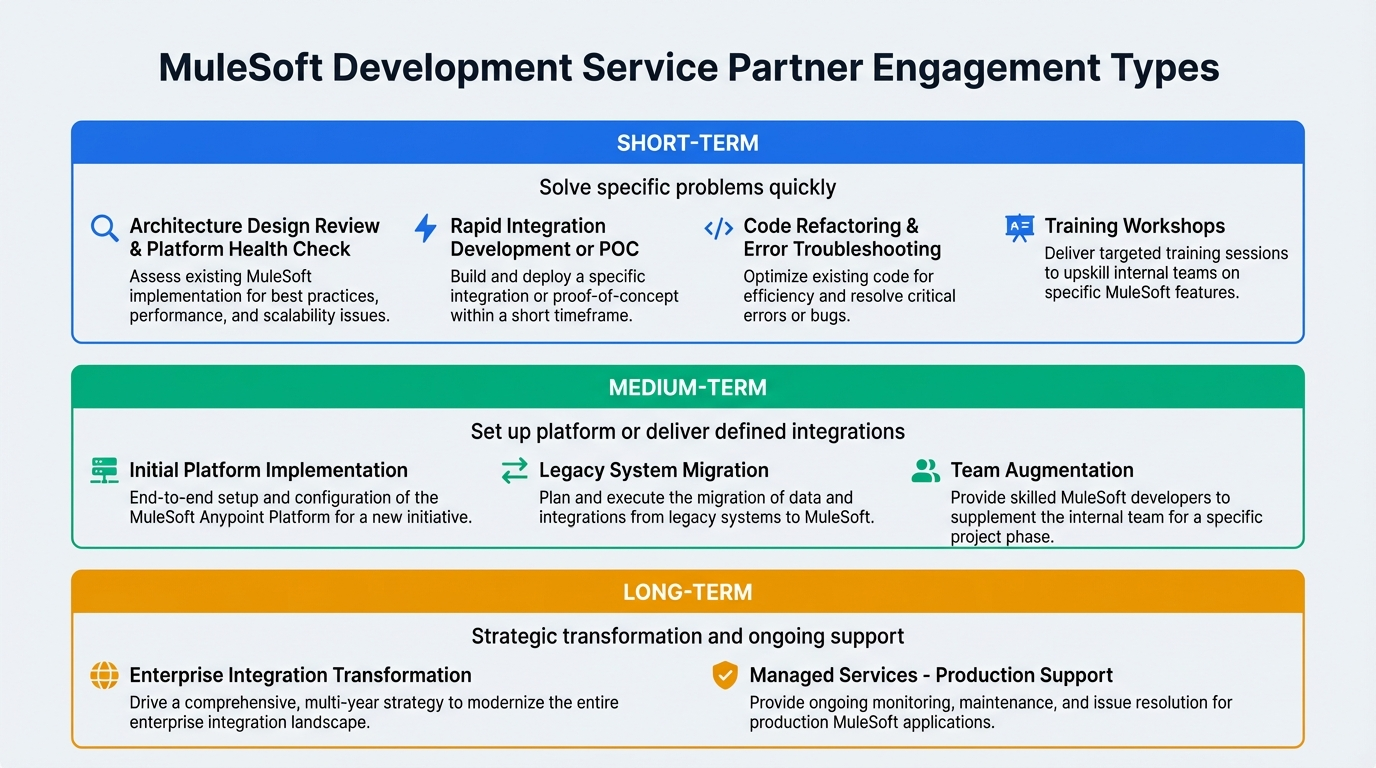
The sections below outline situations in which engaging a MuleSoft Development Service Partner adds value. The scenarios are categorized by typical engagement duration: Short-term, Medium-term, and Long-term.
{{banner-large-3="/banners"}}
Short-Term Engagements
Short-term engagements are used to solve a specific problem quickly, such as reviewing an existing setup, fixing unstable integrations, or building small integrations or proof-of-concept solutions, without changing the overall platform.
Architecture design review and Platform Health Check
As the integration landscape grows, existing integrations can begin to experience performance bottlenecks, architectural inconsistencies, and reduced scalability. These issues can further show up when adding new systems to the integration ecosystem, scaling transaction volumes, migrating runtimes, etc.
Engaging a MuleSoft Development Service Partner at this point can help evaluate the current state and identify risks before they start impacting the business. A focused architecture design review and platform health check typically covers the following areas:
Architecture Assessment and Code Review: Review of integration architecture, API-led layers, and implementation patterns. Code review includes reviewing the Mule code, reliability patterns, error handling, coding standards, logging framework, and design decisions that can limit scalability, maintainability, and reusability.
Performance and security analysis: Analysis of application behaviour under expected and peak loads to ensure there are no performance bottlenecks. Identify issues such as inefficient transformations, synchronous dependencies, and thread exhaustion.
Security analysis, including authentication mechanisms, token handling, encryption, secrets management, and adherence to the organization’s security standards.
API design evaluation: A review of API specifications and contracts to ensure they adhere to best practices for naming standards, versioning, error handling, and client ease of use. The evaluation helps ensure APIs are consistent across the org, follow similar conventions, are easy to understand & use, and are resilient to change, especially when APIs are used across multiple systems.
Developing a single integration rapidly or a proof of concept
Organizations often need to move quickly when developing urgent business processes or validating a technical approach. This could involve building and delivering a single integration between systems or a proof of concept to assess feasibility before the project kicks off.
A MuleSoft Development partner can help accelerate delivery and ensure timelines are met. The partner can help define functional and non-functional requirements, the integration scope, and success criteria. This ensures that for smaller integrations, the scope remains limited and aligned to the business process.
Service Partners helps the organization to build rapid production-ready integrations with essential documentation and a solid architectural foundation. POCs can provide clear recommendations on scalability, identify risks, and estimate efforts before building the complete workflow.
Refactoring code and troubleshooting errors
In many cases, organizations need to fix existing MuleSoft implementations rather than review or redesign the architecture. For example, when integrations experience functional issues, frequent failures, or increased maintenance effort. Organizations can engage MuleSoft Development service partners to help them reproduce and fix errors, review logs, and runtime behavior. The goal is to identify the exact cause of failures rather than providing high-level recommendations.
Service partner teams can help refactor code to correct defects and improve code quality where needed. This may involve simplifying flow logic, correcting error handling, reducing duplication, or improving transformation readability. Changes are kept targeted and scoped, with no broad architectural redesign unless explicitly required.
Troubleshooting activities may include fixing integration failures, resolving data mapping issues, addressing timeout or retry problems, and stabilizing behavior under normal operating conditions. All fixes are validated to ensure existing functionality remains intact.
This engagement is suited to short, focused efforts that stabilize integrations, reduce operational issues, and make the codebase easier to support—without introducing new architecture or changing the platform design.
Training Workshops
As organizations increasingly adopt MuleSoft, it becomes critical to upskill development teams. Engaging a MuleSoft development service partner for specialized training workshops is an effective strategy to address knowledge gaps, especially when:
- Onboarding new developers.
- Expanding into more complex integrations.
- Building deeper expertise in DataWeave, API design, or other MuleSoft-specific areas.
Service Partners can help teams to do an initial assessment of skill levels, common issues, and project context. Based on the result, a tailored plan can be developed to address the gaps rather than focusing on a generic training plan. Training workshops emphasize completing practical, hands-on exercises within the project context to help the team better understand topics such as error handling, logging, dataweave optimization, debugging techniques, and CI/CD integration.
By investing in targeted training workshops at the right time, organizations can increase delivery speed, reduce dependency on external support, and build a stronger, more self-sufficient MuleSoft team.
Medium-Term Engagements
Medium-term engagements focus on properly setting up MuleSoft or delivering a defined set of integrations while laying the groundwork for future MuleSoft integrations.
Initial Platform Implementation
When organizations set up the Anypoint Platform for the first time, it is essential to ensure it is built on a strong, scalable foundation. Platform setup is a critical foundation, as it affects how applications are deployed, platform security, and governance.
Engaging MuleSoft Development Service Partners helps organizations to focus on the following areas:
Platform Architecture and Environment Setup: Configuring the target MuleSoft runtime, such as CloudHub, CloudHub 2.0, Runtime Fabric, or On-Premise MuleSoft servers. Furthermore, setting up development, test, and production environments in line with the organization's structure and needs.
Service Partners configure network connectivity for on-premises systems, VPN networks, and IPsec tunnels to connect to systems within the organization's network. This ensures the platform aligns with the organization’s security and governance standards.
Standards, Governance, and Best Practices: Definition of API-led connectivity standards, naming conventions, error handling patterns, logging, and versioning strategies. Establishing these early ensures consistency across integrations and reduces rework as the platform supports more integrations.
CI/CD Enablement: Setup of continuous integration and continuous development pipelines to ensure automatic versioning and deployment of MuleSoft applications to desired runtimes.
Initial integration, delivery, and knowledge transfer: MuleSoft service partners can also help organizations deliver the initial set of integrations to production and establish standards, integration patterns, and security guidelines for upcoming integrations.
Knowledge transfer ensures that development teams are aligned with the delivered integrations as they build internal capabilities.
Legacy System Migration
Legacy integrations can span across multiple platforms, offer limited capabilities, can become costly and difficult to maintain, and are increasingly risky as vendor support ends. When migrating these integrations to a platform like MuleSoft, it is not just a technical exercise but also an opportunity to modernize the integrations and simplify the overall landscape.
A MuleSoft Development Service Partner supports this transition by evaluating current integrations, developing a future-state design, and implementing the integration in phases. Key activities include:
Current-State assessment and Migration planning: Migration typically starts with documenting the current-state design of the integrations, their processes, workflows, and business-criticality. This ensures that a migration plan is developed based on the assessment, minimizing disruption in connecting systems and aligning with the business priorities.
Future-State architecture and migration planning: This phase focuses on building out a future-state architecture with MuleSoft, showcasing how integrations will work with MuleSoft as the central integration platform.
The architecture is designed to replace point-to-point integrations, optimize current flows, add consistent error handling, and enhance reliability by enabling queueing or other options, as required, to make integrations more resilient.
Incremental Migration: Controlled migration using parallel execution where needed, allowing validation of new integrations while legacy systems remain operational. This reduces cutover risk and supports smoother transitions.
Once the applications are ready for production on the new platform, the integrations are monitored, stabilization support is provided, and legacy components are decommissioned once confidence is established.
Team Augmentation
Sometimes the problem is simple: teams lack the bandwidth to deliver integration work or lack the technical skills. Hiring full-time resources might not make sense for short-term or project-based projects.
Project-based team augmentation adds MuleSoft developers or architects directly into existing teams. They follow the same tools, standards, and delivery process as internal teams. This avoids back-and-forth while maintaining technical ownership with the organization.
Augmented team members bring deep experience with connectors, performance tuning, and complex transformations, helping unblock issues quickly. At the same time, they share knowledge with internal developers, strengthening the team by the end of the engagement.
Long-Term Engagements
Long-term engagements are chosen when integrations are business-critical, require ongoing support, or call for a broader rethink of how integrations are designed, governed, and scaled across the organization.
Enterprise Integration Transformation
Enterprise Integration Transformation is undertaken when an organization feels the need to re-evaluate and re-think the design, delivery, governance, and management of integrations at an enterprise level. Unlike other initiatives that are migration-centric, the focus is not on replacing a legacy system but on developing a sustainable integration operating model that can support long-term business change.
This engagement generally begins with an assessment of how integration work is carried out in the organization today. This includes understanding the organizational structure, development methodologies, deployment models, governance gaps, and the technical environment. Based on the assessment, a future-state integration design is developed that covers architecture principles, delivery strategy, platform standards, and management models.
The implementation is done in phases by introducing API-led architecture as per requirements, standard delivery patterns, and shared capabilities across teams. The existing integrations are brought in line with the standards over time, but the focus is on consistency, reuse, and scalability rather than one-time technical replacement.
The Center for Enablement (C4E) is an integral part of this transformation. The C4E defines enterprise standards, architectural reviews, shared assets, and enablement capabilities that enable multiple teams to develop integrations in a controlled and consistent manner. This enables scalability without centralizing all development.
Capability building is an important outcome of this engagement. Service partners work with internal teams to establish standards, improve delivery, and develop reusable processes. The aim is to leave the organization with an integration platform and management model that can be self-governed and developed over time as the business evolves.
Managed Services - Production Support
Managed Services for Production Support is often chosen when MuleSoft integrations are crucial to the business and require consistent operational coverage. This engagement focuses on the day-to-day operation of the integration platform rather than creating new integrations or changing the setup.
The work involved in managed production support includes continuous monitoring of Mule applications, APIs, and runtimes to detect issues such as failures, performance drops, or resource limits. Issues are prioritized and fixed in accordance with set SLAs, with clear processes defined for each issue.
Service partners handle routine tasks such as log analysis, integration restarts, certificate and credential renewals, patching, and runtime upgrades. They also conduct performance tuning and capacity planning to ensure the platform can handle growth in usage while meeting speed and throughput needs.
Managed services follow clear support models (L1, L2, and optional L3), with defined responsibilities between operations and development teams. Regular reports and service reviews provide insights into platform health, ongoing issues, and areas that require attention.
By outsourcing production support to a MuleSoft Development Service Partner, organizations can maintain integration stability and availability, allowing internal teams to concentrate on developing new integrations and driving business initiatives.
{{banner-large-4="/banners"}}
The Criteria for Selecting a MuleSoft Development Service Partner
Choosing a MuleSoft Development Service Partner is not just about finding someone with the right certifications. The partner you select will influence how your integrations are designed, delivered, and supported over time. Different partners are suited for different kinds of work, and what works well for one engagement may not be the right fit for another.

This section looks at the practical factors to consider when selecting a MuleSoft Development Service Partner, focusing on how well they fit your team, technical needs, and preferred way of working.
Alternative Approach: Using an AI coding platform with their Support Services
The Integration landscape has changed significantly over the last few years, particularly with the adoption of AI-assisted development tools. Before committing to a traditional MuleSoft service partner engagement, organizations should also evaluate AI-powered coding platforms combined with their structured support services.
Modern AI-powered integration platforms combine code generation with implementation support, reducing the need for large external teams. These platforms assist with MuleSoft development tasks such as flow creation, DataWeave transformations, testing, and documentation, while support services help teams make architectural and design decisions when needed.
Use case where an AI platform can be a better fit
The following examples highlight scenarios where an AI coding platform with support services can be more efficient than engaging a MuleSoft Development Service Partner:
To illustrate how the approach works in practice, the following example uses CurieTech AI, an AI-driven coding platform designed specifically for MuleSoft development.
CurieTech AI provides specialized agents for common MuleSoft tasks, including code generation, testing, and documentation. Based on the prompt, the platform automatically assigns work to the appropriate agent, reducing manual setup and coordination effort.
The example below illustrates how CurieTech’s AI platform supports MuleSoft integration development using natural-language prompts. The example features a prompt to create a flow that listens for new opportunities from Salesforce and pushes them into a MySQL database.
Curie asks follow-up questions to ensure it has all the information needed before building the project, such as Salesforce connection details, MySQL configuration details, etc.
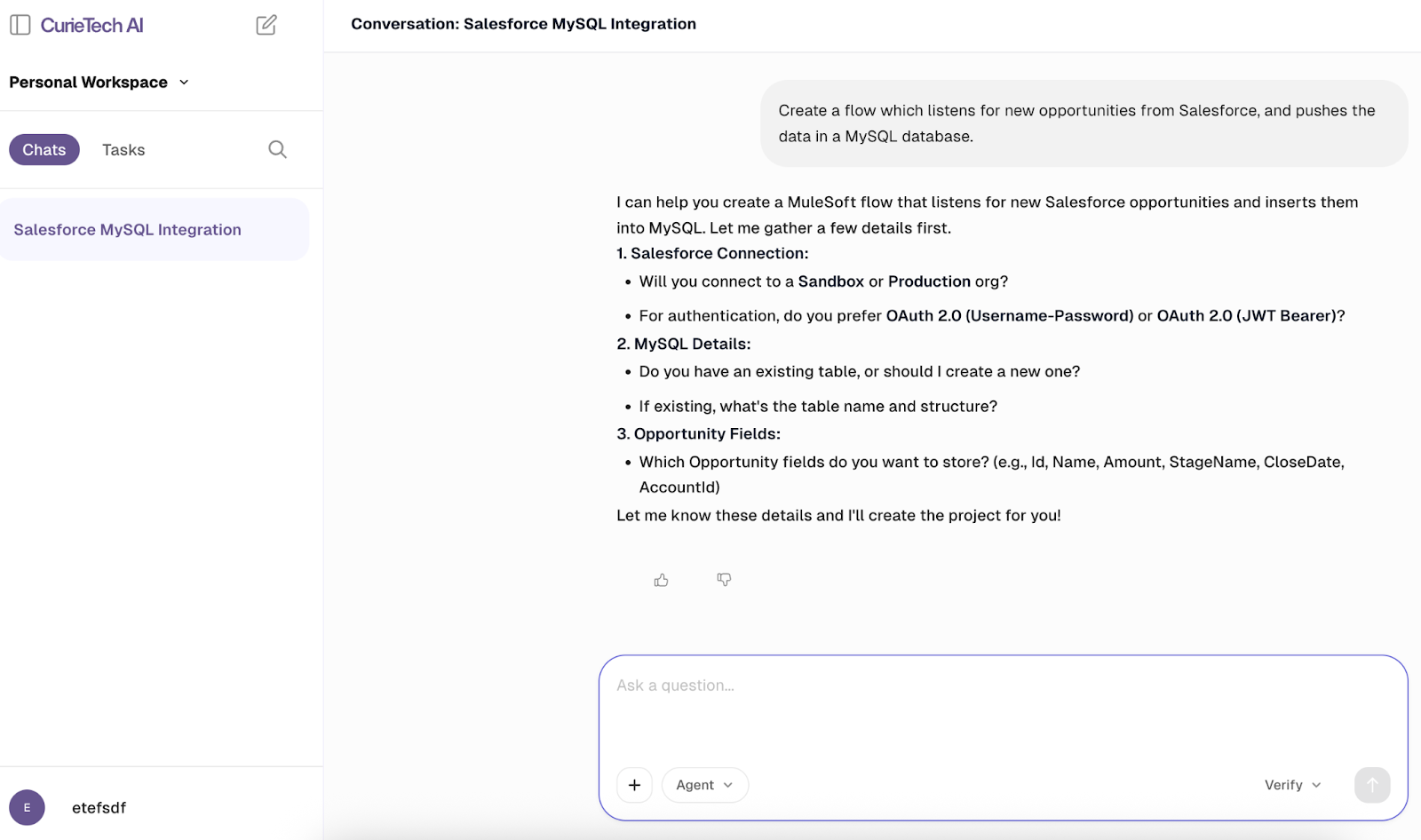
Once the task is submitted, CurieTech AI automatically creates a Repository Coder task for generating the flow without any manual intervention. The agent ensures that the provided application code compiles and works as expected. This also includes documenting the project steps and following standard best practices, such as externalizing properties and dataweave files, consistent naming conventions, etc.
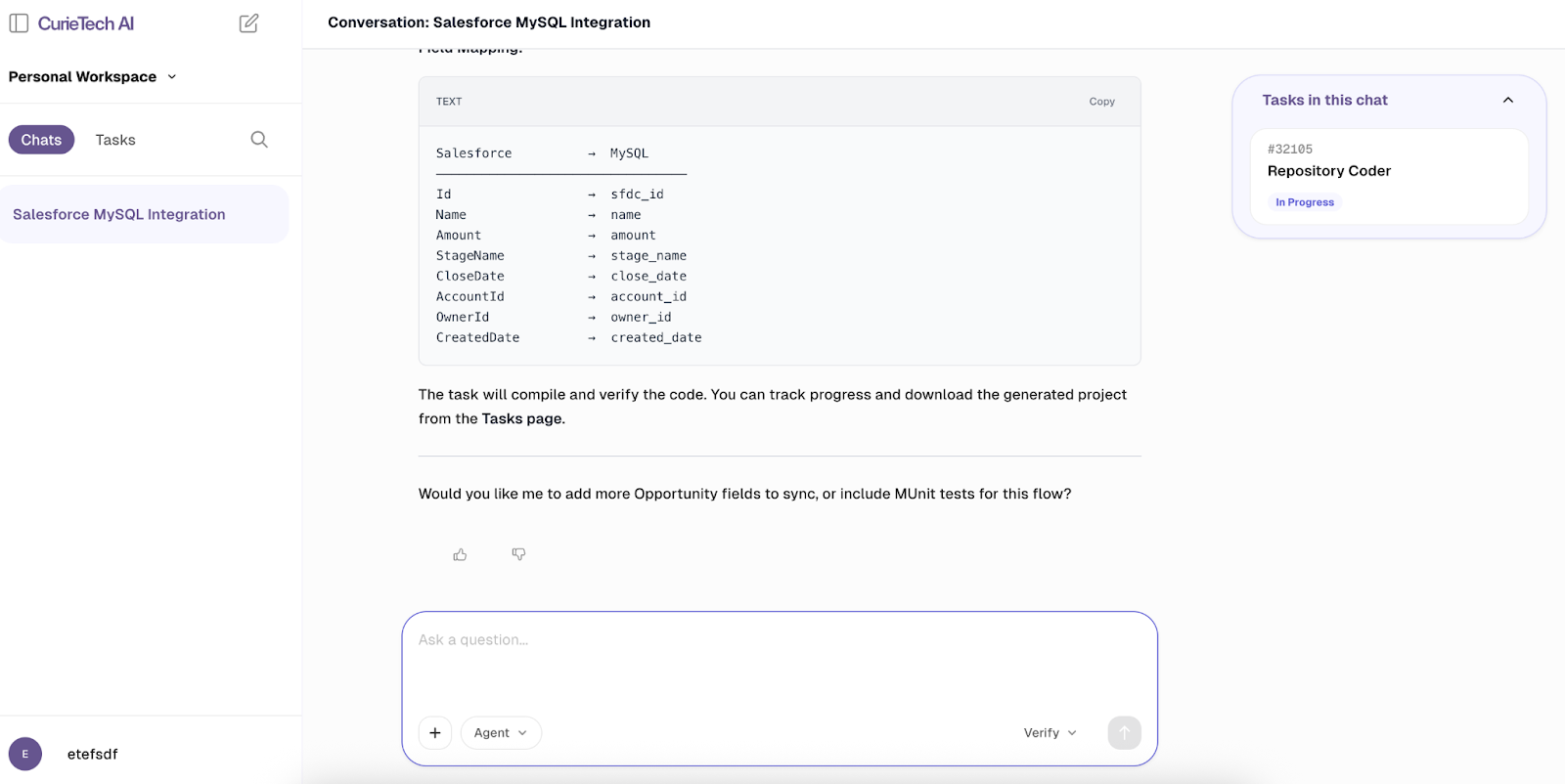
The example showcased a small workflow in which CurieTech’s AI coding platform can be used to develop end-to-end flows with simple natural-language prompts. The platform also supports advanced integration tasks such as automated code reviews, application refactoring, test generation, Java version upgrades, and migration between integration platforms. These capabilities reduce manual effort for repetitive and high-risk tasks.
CurieTech offers a variety of support and professional services for engagements of various lengths to train and assist clients in developing, migrating, and maintaining integrations on the MuleSoft platform.
To learn more about CurieTech, visit their website.
{{banner-large-table-2="/banners"}}
Conclusion
MuleSoft provides a time-tested foundation for developing scalable, reusable integrations, but the success of any integration project depends on the chosen delivery model. MuleSoft Development Service Partners are ideal for complex, long-term, or transformation-oriented projects that demand in-depth knowledge and systematic delivery.
However, AI-powered coding platforms with support services can be an effective alternative for most short-term and medium-term integration requirements. They help develop integrations quickly and at lower cost, with hands-on involvement from the development teams working on them.
By evaluating the strengths of each model and leveraging them where they are most effective, organizations can achieve integration development more effectively while also building a platform for supporting future growth and change.