
The Latest iPaaS Trends and the Agentic Revolution
Integration platform as a service (iPaaS) platforms are evolving quickly. Earlier generations of iPaaS primarily moved data between systems, either point-to-point or via an enterprise service bus (ESB) architecture. A later generation of iPaaS used APIs and the public cloud to exchange data between systems. Today, enterprise integration platforms are increasingly part of agentic workflows, connected via Model Context Protocol (MCP) servers. They are expected to support AI-assisted development, real-time orchestration, governance, observability, and automation.
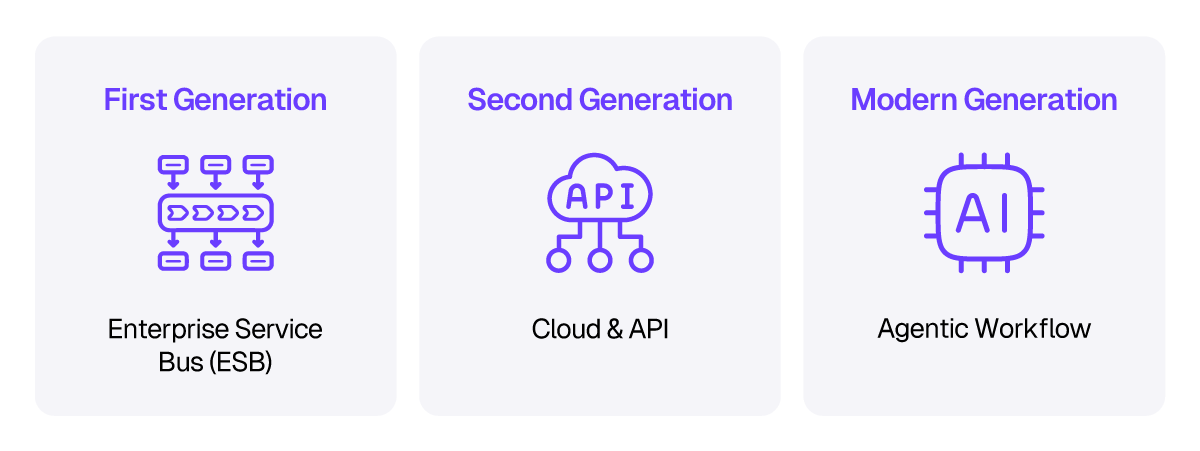
Enterprise expectations around integration have changed over the last few years, too. Organizations now expect integrations to be developed faster, more cost-effectively, and with better security and documentation.
Another important trend is also emerging: While most iPaaS vendors now offer native tooling within their platforms, specialized third-party integration tools are gaining attention because they often offer stronger functionality and broader multi-platform support.
This article examines the most important trends shaping modern iPaaS platforms, with a focus on agentic workflow technologies.
{{banner-large-5="/banners"}}
Summary of concepts related to iPaaS trends
AI-assisted integration development
AI is changing how integration teams design, build, test, and support enterprise integrations. What started as simple code assistance is now expanding into full lifecycle support across requirements analysis, mapping generation, documentation, testing, and operational troubleshooting.
For many organizations, the goal is straightforward: to reduce repetitive engineering effort while accelerating delivery timelines. However, integration engineering introduces complexities that make AI adoption very different from traditional software development.
Unlike standalone application code, integrations work across distributed systems with different API contracts, runtime behaviors, rate limits, retry mechanisms, and business rules. An integration may seem technically valid but can still fail in practice due to wrong assumptions about sequencing, deduplication, pagination, or how the downstream system behaves. This is why integration teams are increasingly treating AI as an assistive layer rather than a replacement for engineering governance.
AI is becoming part of the integration lifecycle
AI is now being applied across multiple stages of enterprise integration delivery. Organizations are using AI to accelerate integration development, generate API specifications from business requirements, assist with data transformations, generate test cases and documentation, and troubleshoot runtime failures.
These capabilities significantly reduce repetitive work, especially in organizations with many integrations, where teams repeatedly implement similar patterns across systems. At the same time, integration architecture still requires strong validation practices. Production behavior is influenced by factors that are often not visible in specifications alone. For example:
- Pagination behavior varies widely across endpoints and APIs.
- Null handling varies between upstream and downstream systems.
- Retry policies can unintentionally create duplicate transactions.
- Currency rounding and time zone logic can introduce inconsistencies in financial systems.
- Connector limitations may only appear under production-scale load.
Because of this, successful AI adoption in integration programs is ultimately measured by operational outcomes rather than development speed alone.
Specialized AI tools are becoming more important
General-purpose coding IDEs are useful for developing simple implementation tasks, but enterprise integration work requires deeper platform awareness.
Integration logic is often distributed across middleware runtimes, connector configurations, transformation layers, error-handling policies, and undocumented operational behavior. Many of these patterns exist outside of traditional code repositories. This has created a growing demand for specialized AI tools for integration engineering across different iPaaS platforms.
Unlike general-purpose development assistants, integration-focused AI platforms can:
- Understand middleware-specific implementation patterns
- Validate integrations against actual runtimes for different platforms
- Support testing and troubleshoot workflows automatically
- Apply governance and architecture standards consistently
- Operate across multiple integration platforms
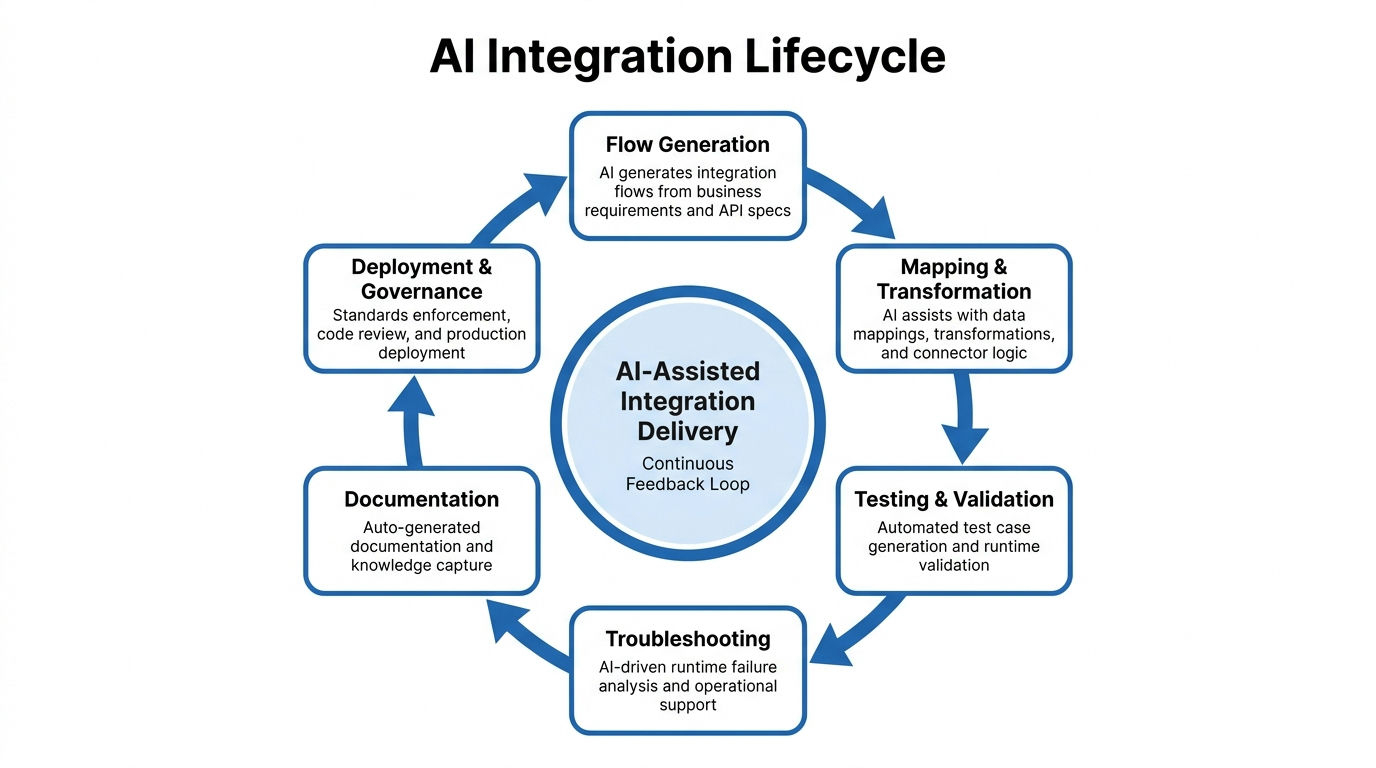
The architectural advantage is not necessarily a better large language model. The difference comes from how these systems and agents are designed, validated, and integrated into the delivery lifecycle. As enterprise integration environments become larger and more distributed, this specialization is becoming increasingly important.
Legacy modernization
Many enterprises still rely on legacy integration platforms that support critical business operations. Technologies such as TIBCO, webMethods, IBM ACE, and BizTalk continue to run large portions of enterprise workloads.
However, modernization is no longer viewed as a long-term roadmap discussion. For many organizations, it has become an operational and architectural priority driven by rising maintenance costs, limited specialist talent, aging infrastructure, and platform support concerns.
AI-assisted migration is accelerating modernization
Traditional migration efforts relied heavily on manual analysis and redevelopment. These initiatives are often expensive, difficult to estimate accurately, and highly dependent on individual developer expertise.
AI-assisted migration tooling is beginning to change this model. Organizations are increasingly using automation to analyze legacy integrations, identify dependencies, generate migration inventories, refactor reusable patterns, and accelerate target-platform implementation.
Modern migration tools are helping teams to:
- Analyze existing integrations and dependencies
- Generate inventories of flows, mappings, and connectors
- Create standardized target-platform implementations
- Develop automated test coverage before deployment
- Identify redundant or obsolete integrations during migration
This improves consistency while reducing manual effort across large modernization programs. More importantly, automated validation and testing reduce the risk of production issues appearing late in migration cycles.
Modernization is no longer just migration
Simply moving integrations from one platform to another rarely delivers long-term value if legacy architectural problems are copied unchanged. Many enterprises are now using modernization initiatives to redesign their integration landscape.
Older environments commonly contain large numbers of point-to-point integrations, repeated transformation logic across multiple flows, inconsistent logging and error-handling approaches, and connector implementations that do not align with modern standards. Architecturally mature modernization efforts focus on reducing technical debt during migration rather than preserving it. This can include introducing layered API-led architectures, consolidating shared transformation logic, standardizing governance patterns, and aligning integrations with modern cloud-native operational models. Organizations that take this approach typically achieve far greater long-term operational stability than those that treat modernization as a simple platform replacement exercise.
API-first integration
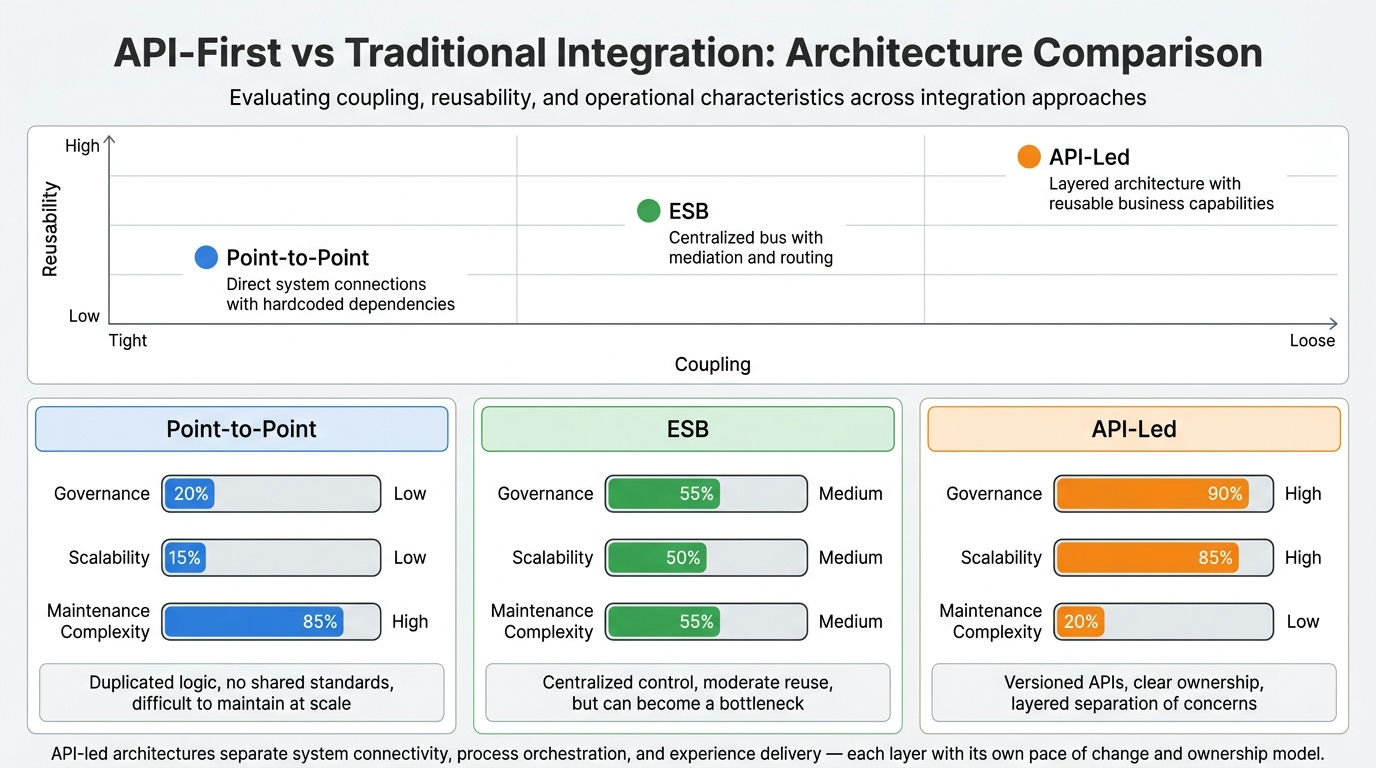
API-first integration remains one of the fundamental principles of modern enterprise architecture. As organizations expose more business capabilities to internal applications, partner ecosystems, mobile platforms, automation systems, and AI-driven services, APIs are increasingly treated as reusable business products rather than simple connection points.
APIs are becoming reusable business capabilities
Instead of building similar integrations for each project, teams focus on creating stable, governed capabilities that can be reused consistently. This shift may seem simple, but it involves important decisions about where business logic is located, who controls it, and how changes are handled among users.
From a design standpoint, this approach has clear advantages. The duplication of business logic decreases significantly when a capability is built once and made available through a versioned, well-managed API. Ownership becomes clearer because each API has defined boundaries and a team responsible for its lifecycle. As more teams use shared capabilities, scalability across projects comes from solid API design rather than repeated integration efforts.
From an architectural perspective, this creates several important advantages:
- Reduced duplication of business logic
- Clearer ownership and lifecycle management
- Better alignment between business domains and technical services
- Improved scalability across projects and teams
API-led integration is still one of the best ways to achieve this at scale. It works because it keeps system connectivity, process orchestration, and experience delivery separate. Each layer has its own pace for changes and ownership model. This separation makes it easier to manage large integrations over time, not just during the initial delivery.
API management capabilities are expanding
As API portfolios grow, governance becomes increasingly important. Modern iPaaS platforms are therefore expanding beyond connectivity and orchestration into broader API management capabilities.
Enterprises now expect integrated support for:
- Authentication and authorization
- Rate limiting and traffic control
- API analytics and monitoring
- Lifecycle governance
- Environment-based policy enforcement
- Versioning and deprecation management
Without strong governance, API growth can quickly create operational complexity and security risks. As a result, API management is now evaluated as a core platform capability rather than a separate architectural decision.
Agentic integration
One of the most significant emerging trends in enterprise integration is the rise of AI agents capable of taking actions across enterprise systems. These agents are expected to create tickets, process requests, update records, trigger workflows, and coordinate activities across multiple business applications.
However, only having AI agents alone is not enough. The integration layer becomes the operational backbone that ensures all actions are carried out securely and reliably.
AI agents require intelligent integration layers
Most enterprise APIs were originally designed for application-to-application communication rather than AI-driven orchestration. As organizations experiment with AI agents, they are discovering that directly exposing low-level APIs creates several operational problems.
In many environments:
- Business logic exists primarily inside integration implementations rather than in reusable service layers.
- API contracts lack sufficient operational context for autonomous decision-making.
- Middleware environments span platforms, teams, and deployment models.
- Error handling is optimized for human-led troubleshooting rather than autonomous recovery workflows.
- APIs expose technical operations, but not the higher-level business intent required by AI systems.
- Authentication, rate limiting, and approval flows are often inconsistent across systems.
- Many APIs assume synchronous interaction patterns, while AI agents frequently operate asynchronously across long-running workflows.
- Integration dependencies and downstream side effects are rarely visible at the API contract level.
- Legacy APIs often return structurally valid responses even when business outcomes fail, making autonomous validation difficult.
- Observability is fragmented, which limits an agent’s ability to reason about execution state, retries, and compensating actions.
All of this makes it difficult for AI systems to use raw APIs reliably at enterprise scale. AI agents require predictable execution models, contextual awareness, clear action boundaries, and operational safeguards. Most existing enterprise API landscapes were not designed with these requirements in mind.
Architecturally, enterprises are therefore moving toward integration layers that expose business-oriented actions instead of isolated technical endpoints. Rather than exposing dozens of low-level APIs, organizations are beginning to expose composable business capabilities such as “Create Customer Onboarding,” “Approve Refund,” or “Provision Employee Access.” These abstractions reduce the complexity of orchestration for AI systems while improving governance, observability, and operational control.
This shift is also changing the role of integration platforms. Integration layers are increasingly serving as execution and policy boundaries for AI-driven operations, not just as connectivity infrastructure.
Business-logic-aware MCP servers are replacing low-level APIs
Traditional MCP servers often act as wrappers over APIs, exposing low-level services directly to AI agents. In enterprise environments, that is not the correct approach. Real business processes involve validations, sequencing rules, permission checks, complex data transformations, and orchestration logic spread across multiple systems.
Business-logic-aware MCP servers address this by abstracting away the complexities and exposing high-level business actions rather than multiple API calls to handle a simple request. Rather than forcing an agent to coordinate several dependent operations, the MCP server encapsulates the workflow internally and executes it as a deterministic, governed action. This approach improves reliability, reduces complexity around handling failures, and makes agentic enterprise integrations more friendly and usable for autonomous AI agents.
The problem
Traditional API-centric integrations expose technical operations instead of business intent. An AI agent that completes a simple task, such as assigning a ticket to a user, may need to make multiple calls in sequence while handling retries, validations, authentication flows, and state management. This increases operational overhead, adds complexity, and increases the risk of failure and inconsistent execution.
This challenge becomes even more significant in large enterprise environments where integrations span multiple platforms, SaaS applications, internal systems, and governance layers. AI agents are not well-suited to manage enterprise orchestration logic at scale independently.
How business-logic aware MCP servers solve this problem
MCP servers that are aware of business logic expose business-level actions that wrap the underlying integration logic. Instead of orchestrating multiple APIs independently, the AI agent interacts only with a governed business capability. From an integration architecture perspective, this is important because MCP servers create a cleaner abstraction layer between AI agents and enterprise systems.
For example, rather than forcing an agent to resolve a user ID, validate project permissions, retrieve ticket metadata, and coordinate multiple API calls and retries, the integration layer can expose a single governed business capability, such as:
assign_ticket_to_user(user_name, project_name, ticket_id)
In this architecture:
- MCP servers expose business-level actions to AI agents.
- Integration platforms handle orchestration and system coordination.
- Governance, validation, security, and audit controls remain centralized.
- Sensitive enterprise logic stays inside managed integration layers.
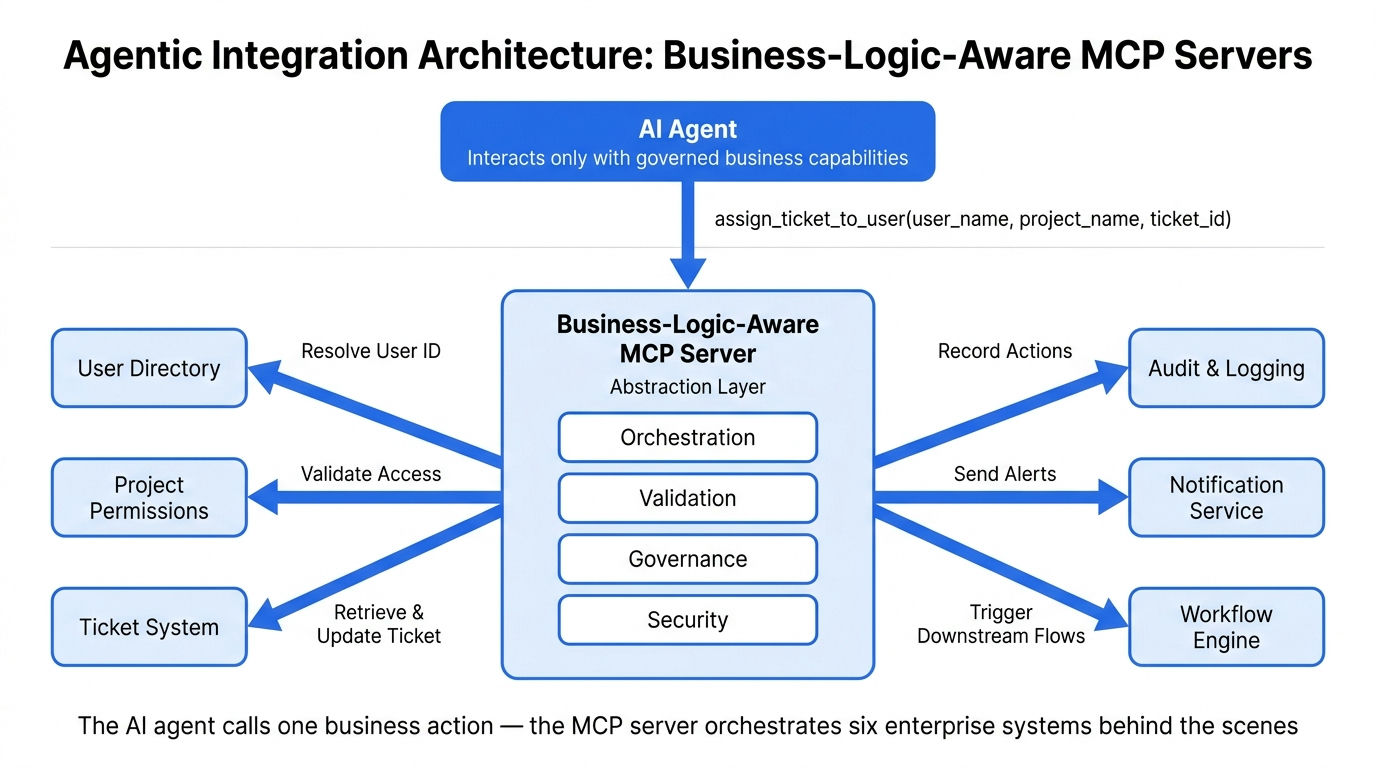
This approach significantly reduces operational complexity for AI systems while improving reliability, auditability, and security. It also aligns naturally with API-led and event-driven integration architectures, where the integration platform acts as the execution and governance layer for agent interactions. From an enterprise integration perspective, this represents a broader shift toward designing reusable operational capabilities that can support both human-driven and AI-driven workflows.
Hybrid and multi-cloud integration
Most enterprises now operate across a combination of cloud platforms, SaaS applications, private infrastructure, and on-premises systems. As a result, in most enterprises, hybrid integration has effectively become the default operating model.
Modern integration platforms are expected to provide secure and consistent connectivity across highly distributed environments while maintaining governance, observability, and operational reliability.
Hybrid connectivity is now a standard requirement
Architecture teams evaluating modern iPaaS platforms are looking beyond connectors and low-code development. The bigger concern now is whether the platform can run reliably across the environments enterprises already have in place.
Most organizations operate across a mix of cloud applications, internal systems, regional deployments, and legacy infrastructure. Because of that, connectivity is only one part of the discussion. Teams also look closely at how the platform handles security across network boundaries, how identities and access controls flow between systems, and whether deployments can meet regional compliance requirements.
In many companies, middleware has grown over time across multiple platforms and teams, which makes standardization difficult. New platform decisions are often driven by the need to reduce that fragmentation. There is also a stronger focus on consistency. Architecture teams do not want cloud deployments to behave differently from on-premises deployments in terms of governance, logging, security policies, or deployment processes. Different runtime behaviors create operational issues later, especially as integrations scale.
The growth of automation and AI initiatives is making these gaps more noticeable. Workflows are becoming longer, more event-driven, and less dependent on human intervention. That increases the need for stable runtimes, predictable behavior, and better operational control. Because of this, iPaaS platforms are increasingly being evaluated as part of the enterprise operating layer, not just as tools for building integrations. Enterprises increasingly expect integration platforms to operate seamlessly regardless of where the workloads are deployed.
Cloud-native integration is expanding
Cloud-native integration is continuing to expand as enterprise architectures become more distributed. Integration workloads are no longer limited to centralized middleware environments running a fixed set of workflows. They are increasingly expected to operate across containers, Kubernetes clusters, cloud services, event streams, and geographically distributed systems.
Modern integration platforms are adapting to this shift by supporting containerized runtimes, Kubernetes-based deployments, distributed execution models, and event-driven integration patterns. Real-time streaming and asynchronous orchestration are becoming more common, especially in environments where systems need to react continuously to operational events rather than wait for scheduled processing.
As these architectures evolve, operational expectations are changing as well. Organizations are no longer evaluating platforms only on connector libraries or development experience. They are also looking at how runtimes behave under scale, network instability, partial failures, and unpredictable traffic conditions.
This is bringing lower-level distributed systems concerns into integration discussions. Architecture teams now pay closer attention to retry behavior, idempotency handling, event ordering, replay capabilities, and failure recovery. Observability has also become far more important, particularly for tracking long-running distributed workflows and meeting service-level objectives.
Overall, enterprise integration is moving away from static request-response workflows toward continuously running distributed systems. That shift is changing both the expectations placed on iPaaS platforms and the way integration architectures are designed and operated.
{{banner-small-3="/banners"}}
Specialized third-party integration tools
Native iPaaS tooling has improved a lot over the last few years. Most major platforms now include their own API management, monitoring, governance, and automation capabilities. If an organization works primarily on a single platform, the built-in tooling is often sufficient.
The problem is that large enterprises rarely stay on a single platform for long. Different systems and integration products get introduced over time through acquisitions, regional decisions, modernization programs, or project-specific needs. Eventually, teams end up supporting multiple integration environments simultaneously.
Multi-platform support is becoming more important
It is common to see enterprises running a combination of MuleSoft, Boomi, SAP, Microsoft, and Informatica along with older middleware products and internally built frameworks.
Most of the time, this is not part of a long-term architecture plan—it happens over the years as different teams make technology decisions independently. One platform gets introduced for cloud integrations, another comes from an acquisition, while older systems continue running critical workloads that cannot be replaced immediately.
The operational side becomes difficult very quickly. Each platform has its own deployment process, monitoring model, governance approach, and tooling. Managing them separately creates overhead for architecture, operations, and support teams.
Because of this, enterprises are increasingly looking more seriously at tools that work across platforms rather than being tied to a single vendor ecosystem. The focus is less on adding more features and more on reducing operational fragmentation.
Teams want common governance standards, centralized visibility, shared testing approaches, and more consistent lifecycle management across the integration landscape. As integration environments continue to grow, keeping operations manageable is becoming just as important as the integration capabilities themselves.
Specialized tools provide broader lifecycle capabilities
Specialized integration-focused tools are gaining more attention because they help solve problems that arise when enterprises operate across multiple integration platforms.
One of the biggest areas is migration. Many organizations are still moving workloads away from older middleware systems or consolidating platforms after acquisitions. Doing that manually across hundreds of integrations is slow and difficult, especially when each platform follows different patterns and standards. Tools that assist with cross-platform migrations are becoming increasingly useful in these environments.
Governance is another reason that enterprises are adopting specialized tooling. Different integration platforms often include distinct deployment processes, testing approaches, and operational controls. Over time, this creates inconsistency across teams. Specialized tools help standardize some of those practices across the broader integration landscape, rather than keeping everything isolated within vendor-specific tooling.
The same applies to testing and observability. Operations teams want common ways to validate integrations, monitor runtime behavior, and troubleshoot issues across environments. Without that consistency, production support becomes increasingly fragmented as integration estates grow.
There is also growing interest in tools that support AI-driven workflows across multiple platforms. Many enterprises are experimenting with AI-assisted development, modernization, documentation, and operational analysis. Cross-platform tooling becomes important because most organizations do not run all their integrations within a single ecosystem.
These trends are also creating demand for platforms focused specifically on integration engineering rather than general-purpose AI development. Enterprises increasingly need tools that understand middleware runtimes, API orchestration patterns, migration challenges, governance requirements, and operational realities across multiple integration platforms.
Enabling AI-driven enterprise integration with CurieTech
CurieTech helps enterprises modernize and scale integration delivery by combining AI-assisted automation with deep integration engineering expertise. Rather than functioning as a general-purpose coding assistant, CurieTech focuses specifically on enterprise integration and modernization workflows.
CurieTech supports organizations across multiple stages of the integration lifecycle, including:
- Legacy integration assessment and migration analysis
- AI automated workflows and transformations
- Integration testing and validation
- Documentation and knowledge capture
- Cross-platform modernization initiatives
- Governance and standards enforcement
- Production troubleshooting and operational support
This allows enterprises to accelerate delivery while maintaining architectural consistency and operational reliability.
CurieTech in a modern iPaaS landscape
Enterprise integration environments today are rarely centered on a single platform. Most organizations operate a combination of platforms such as MuleSoft, Azure Power Apps, and Azure Integration Services. In this landscape, CurieTech positions itself as an AI-powered integration engineering layer that works across these environments rather than being tied to a single platform ecosystem.
The platform supports modernizing integrations by helping teams analyze existing integrations, accelerate migrations, improve legacy integration patterns, and automate testing and validation. This is especially valuable for enterprises running large modernization programs where maintaining consistency and reducing migration effort are major concerns. CurieTech also supports ongoing API and integration delivery through capabilities related to development, testing, troubleshooting, documentation, governance, and code reviews, helping teams standardize integration practices across large integration portfolios.
Another important area is the enablement of agentic AI. Instead of exposing only low-level APIs, CurieTech helps organizations create business-aware MCP servers that expose higher-level business actions to AI agents. This allows AI-driven applications to interact with enterprise systems more reliably and in a controlled manner while keeping orchestration, validation, and business logic within the integration layer itself. Combined with runtime validation and platform-aware integration knowledge, this approach makes CurieTech better suited for complex enterprise integration workloads than general-purpose AI coding tools.
Exploring CurieTech’s capabilities with an example
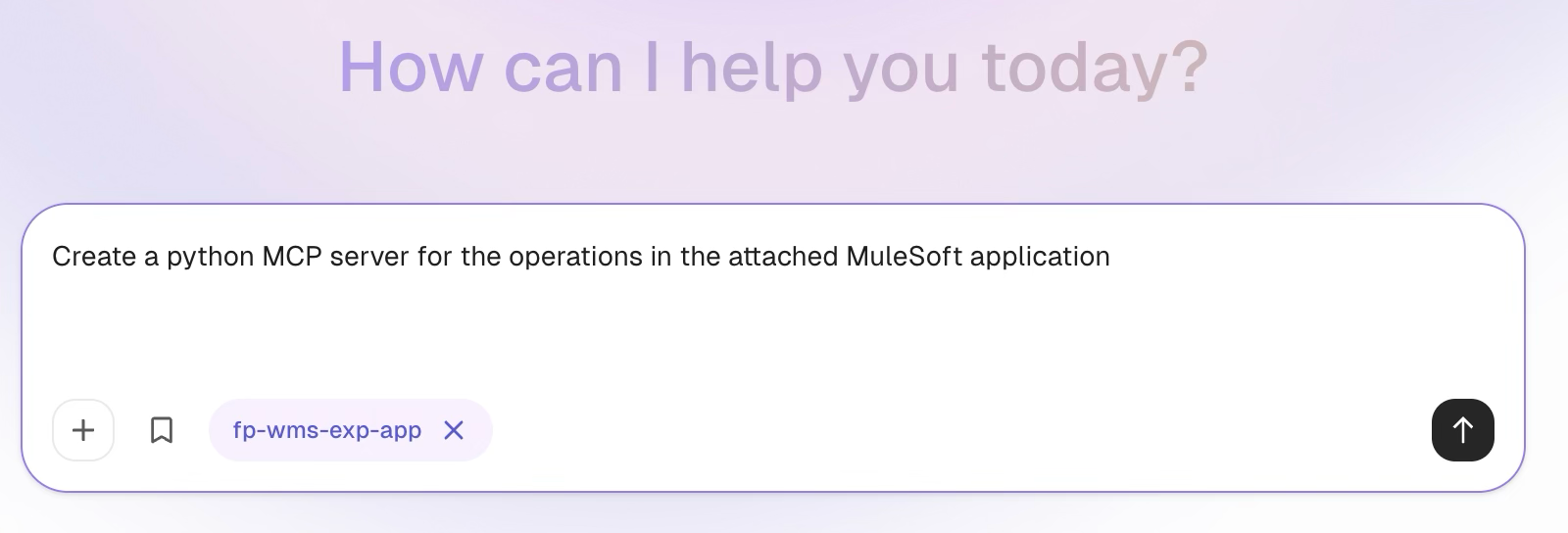
The example below uses a prompt to generate a Python-based MCP server directly from an existing MuleSoft application. A Mulesoft project containing APIs is provided to the agent, and the platform analyzes the integration flows, business logic, and available operations to create an MCP server that exposes agent-ready business actions.
The generated MCP server exposes the MuleSoft application as a set of MCP tools mapped to specific API operations. Each tool represents a business action, including health checks and change-event processing, while preserving correlation handling and existing integration logic.
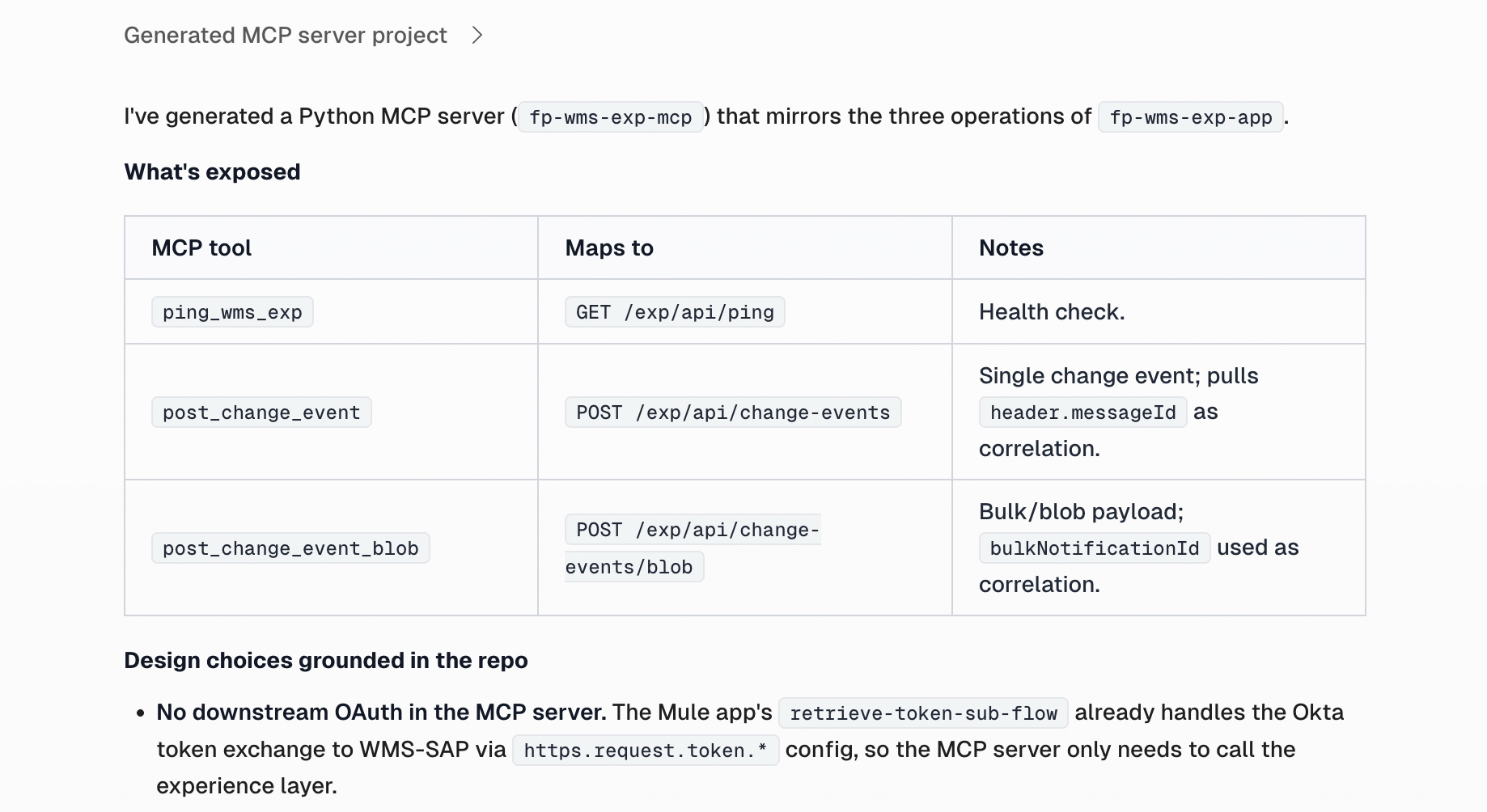
CurieTech also identifies architectural decisions in the Mule application, such as reusing existing OAuth and token management flows rather than duplicating them in the MCP layer. This reduces the effort required to make enterprise integrations agent-ready while preserving existing security, orchestration, and business rules. It also allows organizations to expose reliable business capabilities to AI agents without having to rebuild core integration logic from scratch.
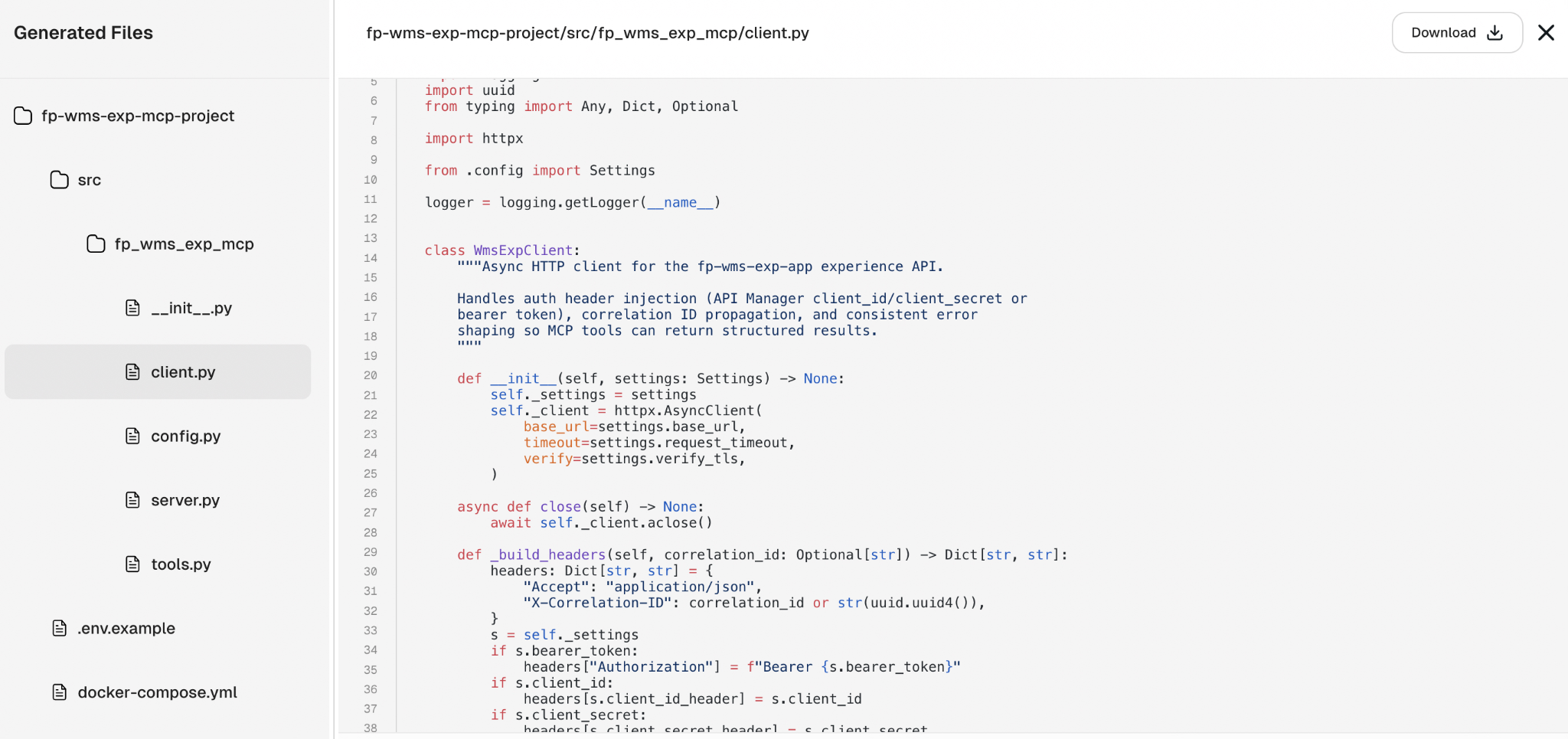
The generated output includes a complete Python-based MCP project created from the MuleSoft application. CurieTech generates the full project structure, including server configuration, API client logic, MCP tools, environment configuration, and supporting files required to run the MCP server. The generated client layer handles authentication, correlation ID propagation, request handling, and structured error management, allowing enterprise integrations to be exposed as reusable, agent-ready business capabilities.
This demonstrates how CurieTech can transform existing MuleSoft integrations into production-ready MCP services with minimal manual development effort.
{{banner-small-3="/banners"}}
Conclusion
Enterprise integration is moving into a very different phase from the one that defined earlier generations of iPaaS platforms. Connectivity alone is no longer enough. Organizations now expect integration platforms to support AI-assisted delivery, real-time orchestration, governance, hybrid deployment models, and, increasingly, AI-driven operational workflows.
At the same time, integration architecture itself is evolving. Enterprises are shifting away from exposing isolated technical APIs toward governed business capabilities that can support both applications and AI agents in a controlled manner.
This is also changing the role of integration platforms. Modern iPaaS environments are increasingly becoming execution, governance, and orchestration layers for enterprise automation at scale.