
As AI becomes more visible in the MuleSoft ecosystem, it is important to distinguish between tools that assist with isolated coding tasks and platforms designed to support integration delivery as a whole. MuleSoft’s Dev Agent (Vibes) and CurieTech AI both aim to improve developer productivity, but they are built on very different assumptions about what MuleSoft developers actually need.
That difference becomes clear once you look beyond quick code generation for simple test scenarios.
Accuracy Over Iteration: Confidence in the First Output
One of the most immediate differences developers notice is agent accuracy.
CurieTech AI is designed to produce single shot, high confidence outputs. Developers do not need to iterate through multiple prompts, refine wording, or guide the agent step by step to reach a usable result. The output is structured, consistent, and aligned with MuleSoft best practices from the start.
This matters because integration work is rarely experimental. Developers need confidence that what is generated will compile, deploy, and behave correctly in real environments.
Where Developers Work, Curie Works: Bringing AI into the MuleSoft IDE
Another practical difference is where developers interact with AI.
CurieTech AI runs natively inside Anypoint Studio and VS Code, allowing developers to stay within their IDE while working through requirements, implementation, testing, and documentation. There is no need to copy context into external tools or switch between browser tabs.
Jira tickets can be reviewed, flows can be modified, tests can be generated, issues can be troubleshot, and documentation can be updated in the same environment where the integration is built.
For MuleSoft developers, this is more than convenience. Integration work is iterative and context heavy, and reducing context switching directly improves accuracy and confidence. Curie becomes part of the development workflow itself rather than a side assistant.

AI for All Skill Levels: When Results Do Not Depend on Knowing What to Ask
CurieTech AI is built on the idea that integration work should not be constrained by individual experience levels. While not every developer is a senior MuleSoft expert, everyone should be able to operate at that level when working with complex integrations.
There is no need for prompt engineering expertise or precise instruction crafting. Junior developers, new team members, and even non specialists can work productively because Curie abstracts complexity instead of pushing it back onto the user. As a result, tasks no longer need to be carefully matched to individual skill levels, which fundamentally changes how teams plan and distribute work.
Tools that rely heavily on prompt refinement tend to favor users who already know exactly what to ask. This limits scalability across teams. Curie’s approach allows teams to scale delivery without scaling risk, regardless of individual experience.
Designing for Long Term Quality and Change: Supporting Upgrades and Migrations
Beyond generation, CurieTech AI places a strong emphasis on code quality and maintainability.
Flow design is optimized. DataWeave is accurate and structured, including transformations derived from real input and output examples. Complex scenarios such as EDI transformations, mapping tables, and regression testing are treated as first class concerns.
This becomes especially important during Mule upgrades and migrations, whether between Mule versions or from legacy platforms to MuleSoft. These are not code translation exercises. They are system level transformations that require understanding existing behavior, dependencies, and edge cases over time.
From Simple to Complex: Sustaining Accuracy as Workflows Grow
Generating a simple flow is relatively easy. Delivering accurate results as workflows grow in complexity is not.
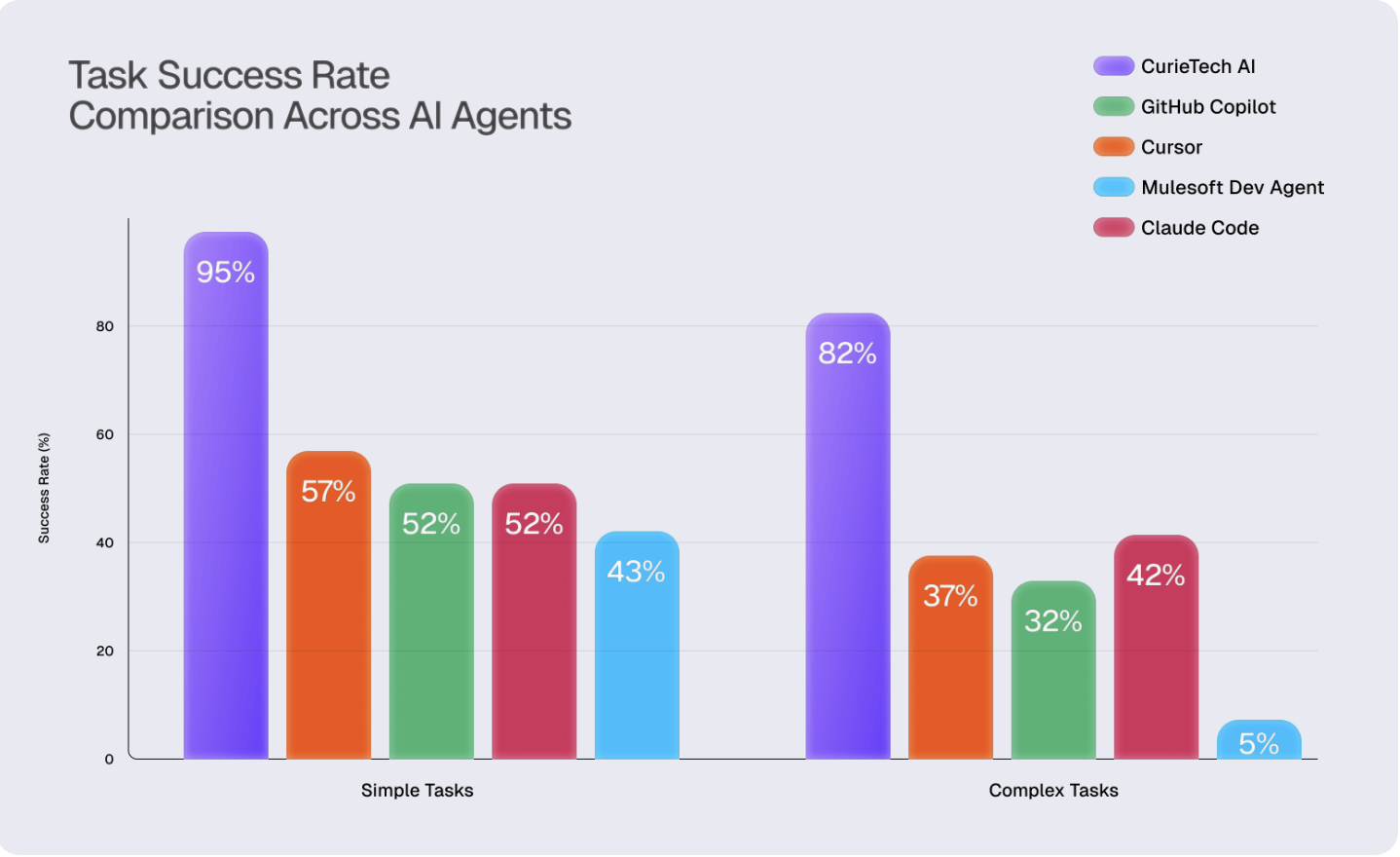
In real integration scenarios, moving from fifty to sixty percent accuracy to consistently achieving ninety percent or higher accuracy is not a matter of better prompts or minor tuning. It requires serious engineering, deep platform understanding, and deliberate design around how complexity is handled.
As integrations expand to include multiple systems, shared logic, complex DataWeave transformations, and layered error handling, the cost of partial accuracy becomes high. CurieTech AI is designed to maintain correctness and consistency as complexity increases, rather than degrading as scenarios move beyond simple cases.
This ability to sustain reliable outcomes across real world enterprise workflows is critical in MuleSoft environments, where integrations evolve continuously and cannot afford guesswork.
Beyond Code Generation: Owning the Full Integration Lifecycle
MuleSoft development is not a single activity. It is a lifecycle.
CurieTech AI generates Mule applications that are complete, compiled, and ready to be deployed. This comes from how Curie approaches code generation by producing structured, production ready projects rather than partial snippets that require manual assembly.
On top of this foundation, Curie provides dedicated capabilities that support the rest of the MuleSoft development lifecycle. This includes DataWeave transformations, unit tests, integration testing, documentation, and troubleshooting. These activities are not treated as disconnected steps, but as complementary workflows built on a deployable codebase.
Multi Repo Context Matters: Integration Work Beyond a Single Project
Enterprise MuleSoft projects are inherently multi repo. Shared assets, reusable logic, cross API dependencies, and platform level consistency all depend on understanding more than a single repository.
CurieTech AI is designed with multi repo context as a first class capability. Code chat, reusability, troubleshooting, refactoring, and optimization work across repositories, allowing developers to reason about systems rather than isolated files.
Most code centric agents operate within a narrow, single repo view, which quickly becomes a limiting factor as systems grow.
More Than an IDE Tool: AI That Fits Real Enterprise Workflows
Integration development does not happen in isolation.
CurieTech AI integrates directly with Anypoint Exchange, Jira, and Confluence. This enables developers to execute complete Jira tickets, work with governed APIs, and generate or publish documentation as part of the same workflow.
This is where Curie extends beyond the IDE. It supports sprint planning, collaborative discussions, and execution without relying on individual heroics.
Curie’s published benchmarks reflect this broader focus on reliability, accuracy, and lifecycle ownership rather than raw code generation speed.
Collaboration at Team Scale: Supporting Multi Developer Integration Work
Integration delivery is rarely owned by a single developer. Teams need shared visibility into ongoing tasks, code context, and progress across repositories.
CurieTech AI supports collaboration at the workspace level, allowing multiple team members to access the same integration context and work together effectively. Teams can connect their Git repositories to a workspace, enabling Curie to operate with shared project understanding rather than isolated individual sessions.
This ensures continuity as work moves between developers. Team members can see what tasks are in progress, understand the context behind changes, and collaborate without re explaining requirements or reconstructing history. Collaboration happens around the work itself, not through disconnected handoffs.
Integration Testing Is Non Negotiable: Shipping Without Guesswork
In integration development, code that compiles is not the same as code that works.
MuleSoft applications interact with external systems, real payloads, and production data patterns. Without end to end integration testing, teams are effectively shipping blind. Issues surface only after deployment, when downstream systems break, contracts fail, or edge cases appear in production.
CurieTech AI treats integration testing as a core part of development. Tests are generated and executed against deployed applications, validating real behavior across flows, transformations, and error handling.
Teams that skip integration testing may ship faster in the short term, but they pay for it later through regressions, firefighting, and loss of confidence.
Where MuleSoft Dev Agent (Vibes) Reaches Its Limits
MuleSoft Dev Agent is effective for simple scenarios, but its limitations become clear as complexity increases.
DataWeave support works for basic transformations but struggles with medium and complex cases, particularly mapping table driven logic. Generated DataWeave from mapping tables is often inaccurate. Code chat outputs are shallow for complex flows, making it harder to understand real systems.
Capabilities such as multi repo code reuse, cross repo troubleshooting, integration testing, regression testing, migrations, and legacy code analysis are not supported. Documentation generation is limited in depth, especially for architectural artifacts like domain or sequence diagrams. Jira and Confluence integration is not available, and collaboration workflows are absent.
These gaps matter because MuleSoft development is rarely about isolated snippets. It is about delivering reliable integrations at scale.
More Than Code Generation: What Integration Teams Actually Need
AI for integration development is not about generating code faster. It is about accuracy, the ability to handle both simple and complex tasks, and producing consistent outcomes regardless of who is using the tool.
CurieTech AI generates compiled, deployable Mule applications as a foundation, then supports the rest of the lifecycle through dedicated workflows. API specifications, flow logic, DataWeave, unit and integration testing, documentation, and migrations are treated as connected responsibilities rather than isolated steps.
By abstracting complexity and embedding best practices, Curie allows teams to operate at a senior integration engineer level by default. This changes how work is planned, delivered, and scaled.
Closing Perspective
Integration development demands more than help at the point of typing. It requires AI that understands systems, workflows, dependencies, and delivery as a whole.
CurieTech AI is built for that reality. For MuleSoft developers, the difference shows up not just in productivity, but in confidence that even junior developers can operate at a senior integration engineer level.
Additional Reading
To deepen your understanding of how AI agents are evolving in the world of enterprise integration, you may find these resources helpful.

.png)
.png)

